Showing posts with label Doc Savage Magazine. Show all posts

Monday, February 17, 2020

John D MacDonald vs. Doc Savage

Babette Rosmond
Bronze Shadows was a fanzine published in the 1960's dedicated to the study of two of the biggest hero pulps ever published, Doc Savage and The Shadow. Created by the late Fred Cook, the 'zine ran from 1965 to 1968 for a total of 15 issues. Like most fanzines of the era, it was homemade, printed on a mimeograph machine and stapled together. It was only one of several such journals centered on Doc Savage and The Shadow.

But it was, apparently, the only one to ever end up in the hands of John D MacDonald, whose early pulp stories filled the pages of these two magazines from 1946 to 1948 when he was just starting out as a writer. This was thanks to the then-editor of both of these pulps, Babette Rosemond, who I have discussed many times in this blog. Here is a paragraph I wrote in 2018 on the subject:

"When writing about the early fiction of John D MacDonald, that period when he was just starting out and learning his craft, enough words cannot be said about the support and guiding influence of pulp editor Babette Rosmond. At that time she was an editor at Street and Smith, managing two of the publisher’s premier titles, Doc Savage and The Shadow magazines, crediting herself as B. Rosmond, probably because of her gender. Like every other editor MacDonald submitted stories to in the that six-month time frame between October 1945 and March 1946 when he couldn’t sell anything to save his life, she was among those who rejected many of his submissions, but her rejections were personal and encouraging. In one rejection letter she wrote, “I, too, am an admirer of atmosphere, but too much atmosphere and too unconvincing a plot make [your story] a weak yarn... However, I am extremely fond of the way you write -- so dry your tears and send me something else very soon." She was an early coach, mentor and -- eventually -- friend who not only helped him in getting a literary agent but counseled him to expand the scope of his stories’ locales.

"To put it in real perspective, of the 57 stories MacDonald had published in his first two years as a writer, 30 of them, or 53%, were purchased by Babette Rosmond."

The second issue of Bronze Shadows was published in December 1965 and one of its contributors made the suggestion to Cook to send a copy to MacDonald. The author responded with the following letter, recalling his time with the magazines, his relationship with Rosmond, and his early pulp career. Below is a transcription of that letter, prefaced and postscripted by Cook:

(John Keasler, whose article appears elsewhere in this issue, suggested that John D. MacDonald might be interested in receiving a copy of Bronze Shadows. Mr. MacDonald, the highly successful author of countless best-selling mystery novels, was sent a copy of #2, and reciprocated by sending along the following article, telling of his early pulp days and his brief association with Doc Savage.

I feel flattered and deeply appreciate the time and effort of such a busy and talented person as Mr. MacDonald, to pause and reminisce with a total stranger.)

JOHN D. MacDONALD vs. DOC SAVAGE
by JOHN D. MacDONALD

I'm glad John Keasler suggested that I receive a copy of Bronze Shadows. I had no idea that a Doc Savage cult was in existence,

You have my permission to use this small and peripheral memory of my association with Doc Savage, though it might give some of the more devoted members of the Savage Coterie an aching desire to take a trip to Sarasota to hit me in the mouth.

I began writing full time when I was sprung after six years in the Army in late 1945. My first attempt at fiction, written while overseas, was sold to Whit Burnett of the old Story Magazine, Consequently my initial efforts - some 800,000 words of unsaleable crud, all in short story form, all completed within a 4 month period, were full of dying blind musicians, incredibly sensitive and oblique dialogue, and everything from imitation Maugham to imitation Tolstoi. I was keeping at least 30 stories in the mails at all times, papered one small room with form rejection slips lost 25 pounds, worked up to 100 hours a week, and acquired a considerable reputation around Utica, New York as a prime case of readjustment problems. No one could understand why I did not put my perfectly good master's degree from Harvard Business to work.

Eight hundred thousand words accomplished in 4 months is in essence a crash training program. It is equivalent to 10 full length novels. No writer of reasonably serious intent can write a single page without learning something of value and improving his control. I sold my second story to Mike Tilden - God rest him - of Popular Publications for Dime Detective in February of 1946. The third one I sold was to one of the Standard Magazines pulps, and the fourth - which was the beginning of a lasting and valued association - was bought by Babette Rosmond of Street and Smith, then editing Doc Savage and The Shadow.

I would estimate that Babs bought forty to fifty short stories of varying lengths from me in 1946, 1947 and a portion of 1948. The first eight or ten were all based on a very personal knowledge of India, Burma, China and Malaysia. She wrote bright, charming letters, but in my mind's eye she was a meaty type in her middle years with a shamelessly evident mustache. From my letters she knew I was a Colonel and she later confessed she had me pictured as middleaged, erect, slight British accent, bulging blue eyes, guardsman's mustache and carrying the inevitable swagger stick.

After those eight or ten based upon the same locale, she wrote to me, saying, “Isn't it about time you took off your pith helmet?”

At about that time I went down to New York to meet the people I'd been dealing with - Mike Tilden, Harry Widmer, Alden Norton. And Babette, who turned out to be a slight, dark, spry gal in her twenties, a very wry and pyrotechnic conversationalist.

Also about that time I was beginning to realize that there were two basic approaches to pulp writing, hence but two kinds of writers. One was the dogged chap who reads and analyzes pulp stories, makes little charts and graphs, develops a clumsy and reasonably direct style and he [...] the stories like a carpenter making different sizes of tables for a furniture mart. The other breed was the group I belonged to, the ones who have no interest in formula or pattern or specific editorial requirements, who want to tell stories, and who, once they accept the minor limitations of the pulp market, take their tongues out of their cheeks and do the best job they can do, and worry later about who might want to buy it. The ratio of work to sales is not as efficient as in the case of the table-makers, because it is a variety of risk-taking, but you can generate considerably more pride in your work, and have more satisfaction in doing it. Working in this manner made the boundary line in those days between pulp and slick very vague. A novelette I thought had its best chance at Cosmopolitan ended up in Dime Detective, A novel I thought might hit Argosy, then a pulp, was diverted to Colliers by my agent, and purchased as a serial.

Insofar as reading pulp magazines, I discovered I could read only those stories by people who were working in the same manner I was. In 1947, Babs Rosmond asked me, very cautiously and tentatively, if I would like to try a Doc Savage. I have the vague memory that Lester Dent was ill at that time. I do remember that I certainly had need of the money. I told her that I would let her know. I got out some of the back copies of the magazine which I had saved because they had contained stories by me. (Some contained two or three by me, the additional ones under the house names Babs and I had devised: Scott O'Hara, Peter Reed, John Farrell.) For the first time I read two Doc Savages all the way through. I did some fretting and some pacing and finally phoned Babs at her office at Street and Smith and said that I could not fault them on the basis of action, or moving the people around, but I just could not bring myself to imitate a prose style so wooden, so clumsy, so labored, so inadvertently hilarious that it was like a parody of the style you might term Early Comic Book. I said that Doc seemed to me to be a truly great comic figure, and I was sorry to let her down, but....

She said she hadn't really believed that I would do it, and that in fact she would have been a little disappointed if I had given it a try, disappointed in me.

I hope the Bronze Cult will understand that I put the knock on the Hero on the basis that any cult has the historical responsibility of assembling the con as well as the pro. I had my chance. I've done some mighty wooden writing under my own name, but at least I never did it on purpose,

(Oboy! How about that? I was introduced to Mr. MacDonald in the pages of Doc Savage and The Shadow along with Thrilling Wonder Stories and Startling Stories. Personally, I have enjoyed his novels more than his short stories because he uses the broader framework to thoroughly develop ideas and characters. I particularly enjoyed The Girl, The Gold Watch And Everything better than most because of the deft development of a most fascinating idea, the complete stoppage of time.

I'm sure we all forgive Mr. MacDonald for this one foolish mistake in his then beginning career.... but then - who are we to argue with success?

Thank you, John, for sharing your start with us. At least for me, you've become a real person in place of just a name on a cover.)

As one might imagine, MacDonald’s comments on the literary quality of the Doc Savage stories elicited several responses, which were printed in issues #4 and 5. JDM again received copies and responded to the objections, which you can read here: Pulp Perspective Plus.


Bronze Shadows issue courtesy of the John D. MacDonald Collection, Special and Area Studies Collections, George A. Smathers Libraries, University of Florida, Gainesville, Florida

Monday, July 9, 2018

"The Little People"

When writing about the early fiction of John D MacDonald, that period when he was just starting out and learning his craft, enough words cannot be said about the support and guiding influence of pulp editor Babette Rosmond. At that time she was an editor at Street and Smith, managing two of the publisher’s premier titles, Doc Savage and The Shadow magazines, crediting herself as B. Rosmond, probably because of her gender. Like every other editor MacDonald submitted stories to in the that six-month time frame between October 1945 and March 1946 when he couldn’t sell anything to save his life, she was among those who rejected many of his submissions, but her rejections were personal and encouraging. In one rejection letter she wrote, “I, too, am an admirer of atmosphere, but too much atmosphere and too unconvincing a plot make [your story] a weak yarn... However, I am extremely fond of the way you write -- so dry your tears and send me something else very soon." She was an early coach, mentor and -- eventually -- friend who not only helped him in getting a literary agent but counseled him to expand the scope of his stories’ locales.

To put it in real perspective, of the 57 stories MacDonald had published in his first two years as a writer, 30 of them, or 53%, were purchased by Babette Rosmond.

Much of MacDonald’s early work reads like just that: the earnest attempts of a man still learning his craft. While the plots and story ideas are strong, characterization and atmosphere still have a long way to go. This is certainly true of “The Little People,” a very early novella published in the November 1946 issue of Doc Savage, an issue that contained three different JDM tales, including “The Scarred Hand,” which was deemed good enough by the author to be included in one of the Good Old Stuff anthologies. “The Little People” isn’t as good as “The Scarred Hand,” but it’s better than the third story, “The Startled Face of Death,” a story that took place in -- you guessed it -- India.

“The Little People” takes place in the United States, specifically upstate New York, where the MacDonalds were living at the time the author wrote this. It’s a sprawling “heist” tale, carefully thought out and nicely executed, but as it goes on it becomes both repetitive and very predictable. Yet taken for what it is -- one of the earliest published works of a man who would go on to become a great writer -- it proves to be both instructive and enjoyable.

With any heist tale there has to be a mastermind, a leader who runs the show, and in “The Little People” it’s a man named Joseph Turin, a criminal whose slight frame is more than made up for by his ruthlessness and steely, “illimitable determination.” He has gathered a team of twenty men, "a collection of village hard guys from Northern New York State, with a sprinkling of city crooks." The plan is nothing less than to rob an entire town. The men have been chosen for their particular expertise, some in firearms, some with explosives, even one who can fly a plane. They gather in an abandoned warehouse in an unnamed location to make their final preparations.

"Now, men," Turin said, his voice low and hoarse with intensity, "before I go over the high spots again, let me tell you that some of you guys are going to get killed on this deal. It's in the cards. That's so you will understand the risks. But the profit is going to make up for it. Those that come through will be set for life. This is going to be the biggest haul in the history of crime. You guys are going to make history. But if any one of you wants to back out now, go ahead."

The medium-sized fictional town of Misoo Falls, New York, an hour or two east of Syracuse, was chosen for its location: only three roads in and out, with its western border taken up by a large lake. The various members of the gang will go in in groups, meticulously timed, blocking all of the roads, cutting the lines of communication and disabling the local radio station. Other teams will infiltrate the town and immediately overtake the small police station, while others will rob all of the town’s banks, its post office, jewelry stores, railroad station and even the local citizens they encounter. In the meantime, a hijacked C-47 will land at the local airport (where all the other planes there have been disabled) and stand ready while the thieves load their swag onto the airplane. Once done, all the teams will gather at the airport and take off, heading west to a secret location where they will split the stuff, separate and "melt away into the quiet places of the world, unsuspected, the possessor[s] of great wealth and a bloody secret that would stand unmatched in the history of world crime..."

There would obviously be some resistance from the citizens of the town, and the teams are instructed to deal with them accordingly:

"Don't shoot unless you have to. Don't let anybody corner you. If you have to shoot, make it a good clean job. We aren't going to be able to avoid knocking off a few guys and once that's done it doesn't make much difference how many more we have to get rid of."

It doesn’t take much imagination on the part of the reader -- especially given the story’s title (MacDonald’s own, believe it or not) -- to realize that the drama of “The Little People” involves how things go wrong at the hands of some of the citizens of Misoo Falls, those who fight back and eventually thwart the well planned heist. These incidents are told in a fairly rote, reportorial style, one after the other, all similar as the gang of crooks slowly dwindles in number. Here's the first such mishap, a good example of all that follow it, showing how one citizen deals with the first entry of the gang:

Buck Deegan was hot, tired and mad. He wheeled the dolly into the truck, loaded on the last box and wheeled it out onto the platform and into the warehouse. He cursed the fates that made him not only a truck driver, but a part-time stevedore. The heavy muscles of his shoulders ached. He stowed the last case and stood for a minute on the loading platform. He looked at the long line of red vans. The rest of the guys had finished and gone out to eat. Only sucker-Deegan was left. He looked curiously at a truck, an open job, loaded with men, that wheeled into the yard at a good clip. Men piled out of the truck and walked toward him.

He recognized the lead man who had worked with him for two weeks and then quit for no reason. He grinned and said, "Hi there, Winny! Who're your friends?" To Deegan's immense astonishment the little dark-haired guy walking beside [Winny] pulled a gun out of his pocket, leveled it at Deegan's middle and fired.

The slug crashed heavily into Deegan and he fell backward as the men swarmed up onto the platform. Through the swirling mists of pain he felt the upsurge of a mighty wrath. The men ignored him. Buck shut his eyes, grasped the fluttering remains of consciousness and bunched his muscles. He reached one hand around behind him and grasped the butt of a small heavy wrench protruding from his hip pocket. Feeling as though he was in a dream, he rolled heavily against a pair of ankles standing next to him.

Dimly, he felt the man fall. He brought the heavy wrench around and felt the deep pleasure as the wrench crunched against bone. He raised it and crashed it down once again into the misty circle of the stranger's face. He lifted it again and it fell with his arm as the second shot smashed the back of his head...

And so it goes, as the local citizens -- farmers, policemen, shop owners and radio station engineers -- all rise to the occasion, retaliate and gradually winnow the gang of men down to a mere handful by the end of the tale. And, of course, things end badly for Joseph Turin…


“The Little People” was submitted to Babette Rosmond along with another story, and in her written reply to the author (dated April 9, 1946) she tells him that she would purchase both of them. She really liked the unnamed story, and mentions that she will probably publish “The Little People” in The Shadow, "going on the excuse that there's a lot of action in it." Six months later it appeared in Doc Savage, giving one an idea of how long it could take from date of sale to date of publication, at least at Street and Smith. In this same letter she offers to help find him an agent (the one JDM was considering apparently was revealing himself to be “a joker”) and she wryly begs his loyalty after he becomes professionally represented. Mentioning a story his would-be agent was trying to peddle, she wrote, “As for "The Bright Flash of Vengeance,” don't worry about it. If your joker sells it, okay -- if not, remember mama." Rosemond would go on to publish that story in the January 1947 issue of The Shadow. (You can read the letter on Cal Branche’s JDM Homepage, here.)

“The Little People” has never, to my knowledge, been reprinted.


Babette Rosmond

Monday, February 29, 2016

"The Tin Suitcase" ("She Cannot Die")

The subject of John D MacDonald’s practice of updating many of the stories in his two pulp collections -- The Good Old Stuff and More Good Old Stuff -- has been discussed often here on this blog when writing about the various stories that made up those two anthologies. But to belabor the point, I’m going to rehash the issue as a preface to this particular posting as context for anyone not familiar with the issue.

In 1981 John D MacDonald, at the time one of the bestselling novelists in the United States and famous worldwide for his series character Travis McGee, was contacted by Francis M Nevins and Martin H Greenberg about putting together an anthology of MacDonald’s early short stories that had appeared in the pulp magazines of the late 1940’s and early 1950’s. Nevins was (and is) a mystery writer, a biographer and expert on the works of Cornell Woolrich, and was a student of MacDonald’s pulp work, having written several articles on the subject in the pages of the early JDM Bibliophile. The late Martin H Greenberg was, without doubt, the greatest anthologist and academic expert on popular American fiction of the last century. According to his Wikipedia entry, he edited or co-edited 1,298 unique anthologies in his lifetime.

MacDonald was, in his own words, “not transfixed with delight” about the idea, worrying about the “overall quality of such a collection.” He agreed to have the two men present him their ideas for such a collection and he put them in touch with his own bibliographic experts, Walter and Jean Shine, who had both a working relationship with the author and a practical knowledge of the holdings of the John D MacDonald Collection housed at the University of Florida. Together the four editors collected and read all of MacDonald’s pulp work (excluding science fiction, which had already been anthologized by Greenberg a few years earlier in Other Times, Other Worlds) and winnowed the pile to thirty stories. MacDonald wanted to review them in manuscript form, so all of the stories had to be typed up from the original tearsheets. He took the stories to his summer home on Piseco Lake in upstate New York and chose 27 of the thirty stories for the now two separate anthologies.

MacDonald wrote that he was astonished that these stories merited republication, but only up to a point. He felt it would “jar” the reader to come across a passage wherein a character paid twenty cents for a quart of milk, or put a mere nickel into a pay phone, so he updated certain aspects of the stories, but only in the ones that didn’t depend on the specific time and place in postwar America. Still, the wholesale changes that he did make were far more jarring to most readers than any reference to a penny candy or to a now-forgotten celebrity. In “A Time for Dying," which was titled “Tune Into Station Homicide” when originally published in New Detective in 1948 (MacDonald also restored all of his original titles to the stories, as many were changed by pulp editors, but at least the original titles were provided in the table of contents), a radio show is updated to a television show, even though someone as savvy as MacDonald had to know that the production of a live radio show in 1948 bore almost no resemblance to a television show in the early 1980’s. In “Trap for a Tigress” (“Noose for a Tigress”) he changed a recent war from Korea to Vietnam but retained the setting of a cross country train ride (updated to Amtrak) even though almost no one of any means was traveling this way in 1981. And in “The Scarred Hand” (“I Accuse Myself”) he updated references from radio to television but retained the threat of lobotomy, even though that particularly horrific medical procedure had long since fallen out of favor by the early eighties.

MacDonald must have been surprised at the animosity from many readers over the changes he made in many of these stories. After all, he had been updating his novels for years. When Fawcett got the reprint rights to his books in the early sixties he went through all of them in order to excise period references. In All These Condemned he changed a reference to Marilyn Monroe from present to past tense. He frequently changed references to then-popular sports celebrities to more current ones. In Contrary Pleasure a reference to then up-and-coming female tennis star Maureen (“Little Mo”) Connelly was changed to Billie Jean King. And let’s not forget Area of Suspicion, which underwent so many changes that its first Fawcett edition featured the blurb on the cover “Specially revised by the author”. So he probably thought nothing of the updating of the pulp stories and was likely frustrated with the ones he couldn’t change.

These changes have a different effect than the ones in the novels, however. As Nevins observed in his Introduction to the first collection, “... MacDonald portrayed more vividly and knowledgeably than any other crime writer the readjustment of American society in general and American business in particular from a war footing to a consumer-oriented peacetime economy, and the redemption and return to the real world of all sorts of war-haunted people on the verge of self-ruination by drink and detachment… perhaps enough remains of the ambiance of the late forties and early fifties to demonstrate how the best crime fiction of any period bears witness to later generations about the way we lived then.” That “perhaps” was overly optimistic, and some of the stories are quite nearly ruined by MacDonald’s changes.


Take “The Tin Suitcase”. Originally published in the May-June 1948 issue of Doc Savage (under house name Peter Reed), all references to the protagonist’s war experiences were removed, completely altering the mood and motivations of the original story. In addition, there were literally dozens of other changes made that had nothing to do with the period, disproving MacDonald’s assertion that he did so only in cases that “might confuse the reader”. I know this from having read the two versions of the story side by side, an exercise I hadn’t tried before, and it got to the point where I decided to document all of the changes made to the original. Two pages of a notebook were filled before I gave up. If “The Tin Suitcase” is any indication, the changes MacDonald made to these stories were far more sweeping than I originally believed.

If your first exposure to the story came from the pages of The Good Old Stuff -- mine was -- then the plot of the story you read goes like this. Protagonist Jud Brock is employed as a low-level worker at the Brasher Scrap Metal Company in the city of Louisavale. As he is working out in the yard one day, a secretary comes out of the office with the intention of handing Jud his daily work orders. Stella Galloway is also a friend of Jud’s and they have gone out together on several dates. Suddenly a shot rings out and Stella falls to the ground, a bullet in her back. She is alive, but barely, and is taken to the hospital to hopefully recover. When the cops arrive we learn that Jud himself used to be a cop, but was thrown off the force after a breakdown following the murder of his young wife. He has taken the job at Brasher Scrap Metal as a means of recovery, and had mended well by the time the story begins, but it doesn’t stop the cops from needling him mercilessly when they discover him on the scene. Jud’s cop instincts take over and he gets the owner of the business to agree to let him investigate what happened, and even the cops grudgingly agree, as long as he stays out of their way. It is determined that the shot must have been fired by someone at the business, as no one from the outside could have gained entry to the yard when the attempted murder took place. MacDonald begins rolling out the various suspects, including  the business owner, a normally mild mannered chap who fires Jud after the shooting for a relatively minor act of insubordination, and a scrap purchaser who had worked with Stella at a previous employer. There’s also the possibility that the bullet had been meant for Jud himself, and that Stella had gotten in the way.

After the cops see what a changed man Jud is they become more agreeable to him using his considerable investigative skills to help them solve the mystery, and they begin gathering, then eliminating all of the possible suspects until there are only a few, and some things simply don’t add up. All the while, Stella lies in a hospital bed fighting for her life…

The most interesting part of “The Tin Suitcase” -- the best written and most engaging part -- is a lengthy account of how Jud lost himself and hit bottom. Even The Good Old Stuff version of it retains some of its original power:

They all knew the story of Jud Brock. He had put in six years with the Louisavale police, going on the force directly from college. He had advanced rapidly, had been transferred to Homicide, where he worked under Captain Davis. He was looked on as one of the bright young men in the department. Since Louisavale was a city of two hundred thousand, he could plan on merit promotions to the point where he would make a good living and have a responsible position. He was popular and he liked his work and he was good at it.


During his sixth year on the force he became engaged to Caree Ames. She was a slender, enchanting blonde, the only daughter of the city manager.


They were engaged for just two months before they were married. She seemed pleasantly but curiously anxious to be married, as though it would be some sort of haven for her.


Five weeks after the wedding and three weeks after they had returned from their Bermuda honeymoon, he came home to their new suburban house to find that a man with whom Caree had been intimate before he had ever met her had broken into the house, shot her twice in the skull, and then shot himself. She was dead. The man was still breathing. She had died almost within reach of the telephone. The man lived in a coma for five days before he too died.


He could not get that kitchen scene out of his mind, the two of them  on the vinyl pattern he and Caree had selected, both face down in the pattern of a grotesque T, the still-breathing  man lying across her dead legs.


Later he found out that quite a few people had known of her affair with the man who killed her. Her father had been anxious for her to be married. The man was demonstrably unstable, potentially dangerous.


For two months after the funeral he had continued his duties, walking through each day like a mechanical man. He had found he could not forget that scene; it was inextricably mixed somehow with some of the bloodier episodes which had happened during his years of police duty before he had met Caree.


During those two months, all the reality of the world around him took place dimly behind the shining screen of memory, and at last he had discovered that alcohol would dim the memories. At first he had been suspended for a month and had managed to get himself in shape to go back to duty at the end of the month. The second suspension was for six months.


After a long period of forgetfulness, he had walked into headquarters, his broken shoes flapping on his feet, his gray face dirty and whiskered, and found out that his suspension had been  up for over three weeks and that he had been suspended indefinitely.

Compare that with the original passage as it appeared in 1948:

They all knew the story of Jud Brock. Before the war he had put in two years on the Louisavale police force, going on the force directly from college. He had advanced rapidly, had been transferred to Homicide where he worked under Captain Davis. He was looked on as one of the bright young men in the department. Since Louisavale was a city of two hundred thousand, he could plan on eventually getting a very good position on the force. He was popular and fond of his job. He was engaged to Caree Ames, the sleek blonde daughter of the City Treasurer.


He was drafted in the fall of '40, went into the Infantry, earned a field commission in the Marshalls, was wounded in Saipan, placed on limited duty and transferred as a Captain to Air Corps Intelligence. In a Burma flight with the 10th Air Force, they were forced down and he spent two years as a Jap prisoner working in the rice fields near Rangoon. He was liberated in early '45, after a stay in the General Hospital in Calcutta, was shipped home and discharged at Dix with the rank of Major.


He married the blonde Caree Ames. She had acted odd about his return, and had seemed very anxious to be married. Three weeks later, during his first week back on the force, the man with whom she had been intimate during Brock's years overseas had broken into Brock's new house, had shot Caree and then himself. Caree had died immediately and the man had lived in a coma for five days before he too died. It was only then that Brock learned what had existed between the two of them while he had been away.


Brock had come home and found the two of them on the kitchen floor, the man still breathing, lying across Caree's dead legs.


For two months he had continued his duties, walking through each day like a mechanical man. He found that he could not forget the way the two of them had looked on the kitchen floor and it was inextricably mixed with memories of some of the unbearable days of captivity, and somehow through it all he recaptured that moment of intense surprise when the Jap mortar shell had dropped into the soft sand beside the shallow hole he had scooped and had tossed him a dozen feet in the air...


During those two months all the reality of the world around him took place dimly behind the shining screen of memory and at last he had discovered that alcohol would dim the memories. At first he had been suspended for a month and had managed to get himself in shape to go back to duty at the end of the month. The second suspension was for six months.


After a long period of forgetfulness, he had walked into headquarters, his broken shoes flapping on his feet, his grey face dirty and whiskered and had found out that his suspension had been up for over three weeks and that he had been suspended indefinitely.

Notice how when MacDonald changes one thing it forces him to  make other changes he wouldn’t have made otherwise simply for the sake of “updating”. By eliminating the war years he eliminates the affair Jud’s fiance had while he was overseas, requiring the author to have Caree now be killed by a former boyfriend. One could argue that it was Caree’s unfaithfulness more than her murder that caused Jud’s breakdown, a subtle bit of business that adds a deeper layer to the reader’s understand of the character, now missing altogether from the altered piece. The horrible memories of the POW camp are replaced by MacDonald’s odd addition of the dead couple “on the vinyl pattern he and Caree had selected, both face down in the pattern of a grotesque T, the still-breathing  man lying across her dead legs.” It’s clear in the original that Jud’s war memories are a large part of his breakdown, especially with the added bit about the mortar shell. It’s as if MacDonald had removed a vital support in a building, only to have to shore up the weakness elsewhere by other means, thereby weakening and changing the finished product entirely.

Some of the other changes MacDonald made throughout the entire story are in keeping with his intention of updating: increasing the cost of something from forty-four dollars to eighty-eight; changing a reference from boxer Primo Carnera to Superman; changing the phrase “gay as a lark” to “happy as a lark”; and, in the one war reference he couldn’t eliminate, changing “war surplus” to “Viet Nam surplus”.

Others make no sense and belie the author’s assertion in the Foreword that he “was horribly tempted to make other changes, to edit patches of florid prose, substitute the right words for the almost right words,” but didn’t because “that would have been cheating, because it would have made me look as if I were a better writer at that time than I was.” How else to explain some of the following alterations?

Original:     Two men with a detector were left back…

Update:    Two men with a metal detector were left back…

Original:    "I'm sorry. I'll pay you the hundred and twenty-one bucks. I'm sorry."

Update:    “I’m sorry. I’ll pay back that money. I’ve got it in savings. I’m sorry.”

Original:    "... the gal who turned him down getting palsy with... well, with a common laborer."

Update:    “... the woman who turned him down getting chummy with… well, with unskilled labor.”   

Original:    "She's had two more plasma transfusions, but she's losing moisture so fast that 
                 she'll be due for another one soon."

Update:    “She’s had two more plasma transfusions, but she’s losing fluids so fast that she’ll be due  for another one soon.”

Original:     “... a few times we went to the coke bar at the Pentagon…she was a nice neat girl and  very quiet.”

Update:    “... a few times we went to the cola bar at the Pentagon… she was very nice in a quiet way, very tidy and polite.”

I could go on with lots more, but you get the point. Cleaning things up? Yes, probably. Trying to make it seem he was a better writer at the time than he was? You be the judge.

So now I’m left with the gnawing feeling that I should go back and reread all of the Good Old Stuff stories in their original pulp form, where I have that opportunity. Unfortunately I don’t own a lot of the stories in the original magazines, so I’ll have to guess. But what I once thought was minor tinkering, where I could read an updated story and make substitutions in my mind with what was written for what had probably been written, no longer seems the case. Certainly not with “The Tin Suitcase.” The only real improvement I can see in MacDonald’s update is his restoration of the original title, “She Cannot Die.” Unfortunately, the better title is attached to the inferior story.

(A special thanks to Trap of Solid Gold reader Eric Gimlin for supplying me with a copy of the original story.)

Wednesday, December 15, 2010

"The Startled Face of Death"

"The Startled Face of Death" was one of three John D MacDonald stories published in the November 1946 issue of Doc Savage. Appearing under the house name "Scott O'Hara," it was joined by the author's "The Little People" (a novella, and credited to JDM) as well as "The Scarred Hand," a story credited to "John Farrell" and one good enough to to pass muster for inclusion in the author's 1984 pulp anthology More Good Old Stuff.


That two volume collection (The Good Old Stuff in 1982 and More Good Old Stuff two years later) was edited by several people, including the ubiquitous Martin H. Greenberg, JDM bibliographers Walter and Jean Shine, and Francis M. Nevins, a St. Louis University School of Law professor who was also a mystery writer and an expert on American mystery fiction. Nevins was a frequent contributor to the early, Moffatt-edited version of the JDM Bibliophile and was virtually the only writer in that journal -- or any other -- who seemed interested in studying MacDonald's early short fiction for purposes other than listing the name, date and location of its publication. He was a noted expert on the works of both Ellery Queen and Cornell Woolrich and was perhaps the first writer to detect the strong similarities between Woolrich and the very early short fiction of John D MacDonald. Nevins had written a work on Queen in 1974 (Royal Bloodline: Ellery Queen, Author and Detective) and would later co-author (with Ray Stanich) a shorter work on the various appearances of Ellery Queen in dramatic radio, The Sound of Detection: Ellery Queen's Adventures in Radio (1983), a book I purchased and still own. In 1988 he would write the first (and as far as I can tell, still the only) biography of Cornell Woolrich, a massive volume blessed with the wonderful title Cornell Woolrich: First You Dream, Then You Die.

In 1978 Nevins contributed a paper to a conference on the works of John D MacDonald sponsored by the University of South Florida in Tampa. Titled "The Making of a Tale-Spinner: John D. MacDonald's Early Pulp Stories," it discussed a variety of those early pulp tales in order to prove the thesis that MacDonald was not "building a private literary world but working within established modes and strengthening his skills in a breathtaking number of directions at the same time." The paper mentions over a dozen specific titles and remains -- again, as far as I know -- the most detailed work on MacDonald's pulp work to date. MacDonald himself attended the conference and commented on each paper as it was read. Those off-the-cuff comments were later reprinted in an issue of the JDM Bibliophile, providing MacDonald fans with some of the most detailed and interesting history of his early days as a pulp writer. In 1980 those same papers were printed in the inaugural issue of Clues: A Journal of Detection and, again, MacDonald provided commentary for each study, this time in writing, after a more careful study of the works in question.

In Nevins' paper he makes mention of "The Startled Face of Death," calling it "a quite decent early MacDonald" containing an atmosphere that was "thick, steamy and authentic." I'm afraid I will have to disagree with Nevins on this one. What begins with a terrifically written scene eventually devolves into a meandering tale of detection that relies on too much happenstance and too little characterization. The story itself contains the skeleton of an interesting mystery story that is unfortunately undone by the brevity in which MacDonald tells the tale, lacking anything resembling the kind of character development that the author would eventually master. The mystery, on its own pulp terms, works, but only barely so, leaving the reader greatly underwhelmed by the solution.

The setting for "The Startled Face of Death" is Delhi, India, a place the author knew well from his war years and one he hated equally well. Sam Carroll is employed in a job that was MacDonald's favorite private eye-substitute, an insurance investigator, and he harbors the same feeling for the country that JDM did. The MacGuffin of the tale is a necklace made up of twenty-two square cut emeralds, a necklace that was paid for six years before the story begins by an import firm by the name of Bartan and Adams. They had wired thirty-three thousand dollars to their agent in India in 1940, a man by the name of Holley, who cashed the draft, purchased the necklace and then disappeared off the face of the earth. Bartan and Adams' insurance company made good on the loss and then sent their own agent to try and find Holley. That agent determined that Holley had died in possession of the necklace in Old Delhi. The agent would head there to follow up on a lead. A month later the insurers received word that the agent was found outside the Red Fort with his throat cut from ear to ear. The company was on the verge of sending Carroll over to follow up when the war intervened and the case grew cold for five years. But now the war is over and the insurance company still wants to find out what happened. Enter Carroll, again.

Sam Carroll reflects much of the author's dislike and disdain for the country, repeatedly referring to the "stinking" city of Delhi and to the constant irritation of the incessant heat. He doesn't think too much of Indians, either. Carroll is none too happy about being there and none too happy about being sent to work on such a cold case. But this is a JDM protagonist, so not doing his job as professionally and as diligently as possible would be out of the question. As the story begins it is four in the morning and Carroll is trying to sleep in his furnace-like hotel room. The only way he can even hope to get any rest is to use "the formula": soaking his bedsheet in water, wrapping himself in it and laying down on the bed directly under the ceiling fan. The only problem comes if you awaken in the middle of the night; then you have to do it all over again.

Carroll has awakened and can't get back to sleep, giving MacDonald the opportunity to write a nice, evocative paragraph setting the scene nicely.

"I couldn't get back to sleep, and I lacked the energy to get up and go into the bath to soak the sheet again. I judged that I had been asleep for some hours, as the sheet was dry on top of me. I listened and heard the gabbling bay of the troops of jacks which wandered into New Delhi each night. I heard the clop clop of the tonga horses on Queensway and wondered who would be riding around in the parching night air. Above me the big fan whirred. I could feel the heat still radiating from the thick plaster walls of the hotel room, heat picked up during the blaze of the sun on the previous day."
 
While Carroll is lying in bed he detects a vague movement in his room, a "dark blob" too indistinct to make out. Soon he realizes that there is someone else in the room with him.

"It could be a routine hotel robbery or it could be... I seemed to hear once again the voice of old Ben Harfer, the company representative in Calcutta, repeating what he had told me as we has sat sipping gimlets by the pool at the Tollygunge Club. He had said, 'You don't know this country like I do, Mr. Carroll, and even though I've been here thirty years, I don't claim to know these people. They're sly and devious, and if you get close to what you're after, you will be stepping on somebody's toes. Take it very, very easy. The fact that you're American won't keep a knife from slipping into your throat if one of these beggars decides to put one there.'"
 
Clearly, John D MacDonald did not have fond memories of India.

Waiting for the right moment, Carroll leaps at the figure in the dark, only to have the door slammed in his face. He runs down the hall but the intruder has disappeared. As he returns to his room he notices a dagger lying on the floor of the hall, a knife with a short, bright curved blade, with "a handle of pale green Indian jade, cheap and opaque. It looked Moslem in design..." Back in his room he checks his suitcase, sitting on a stand near the porch doors. He uses the knife to flip open the lid.

"I jumped back a good six feet, and that didn't seem far enough... On top of my folded clothes were two huge scorpions, sand colored and evil. The larger of the two was at least three and a half inches long, the smaller was only a fraction of an inch shorter.They both climbed over the edge of the suitcase and dropped onto the floor, their horny skins clattering on the stone. One scuttled toward the porch and the smaller one came toward my bare feet, its long segmented tail folded back with the stinger just over its head. It came nearer and I turned and ran into the bath."
 
Carroll manages to kill the terrifying insects and comes to realize that the scorpions were placed in his room not to kill him -- scorpions couldn't do that -- but to scare him off. Of course, that meant that he was getting close to something or someone, but who or what? He redoubles his investigative efforts and is eventually is told by a hotel manager that when Holley's body was found five years ago, he noticed that the corpse's face wore an odd expression, "... a look of surprise as well as fear, as though it was the last thing he expected."

The remainder of "The Startled Face of Death" is little more that Carroll hunting down clues, until he comes upon the man he suspects, a character the reader hasn't been introduced to until that very moment, confronts him, fights him, and... well, there's very little surprise at this point, and the whole tale seems like a big letdown after that great scorpion scene.
MacDonald's early tales are full of stories set in India and Ceylon (now Sri Lanka), the places where the author was stationed during the war. "The Startled Face of Death" is structurally identical to another early JDM story, "They Let Me Live," a far superior work that also appeared in Doc Savage, concerning an American returning to the far east in order to solve a cold-case mystery. It was included in the first Good Old Stuff collection, while "The Startled Face of Death" has never been anthologized. In his Introduction to the first volume of the anthology, MacDonald relates that the editors had originally presented him with thirty stories for re-publication and that he approved all but three. I've always wondered what those three stories were. Based on Nevins' specific praise for "The Startled Face of Death" and the fact that it appears in neither collection, it's a good guess that this story was one of the three rejects.

Nevins has recently published a collection of some of his writings, redone as something he calls Cornucopia of Crime: Memories and Summations. It's a fascinating and addictive collection of remembrances about his life as a writer, editor and collector of mystery fiction. His chapter on JDM is basically a rewrite of "The Making of a Tale-Spinner," but he includes a brief biography and an interesting final paragraph recalling his stint as co-editor of The Good Old Stuff anthologies. He addresses the baffling decision by MacDonald to "update" some of the stories and relates that this practice was done over "howls of protest from all four editors," and rightly points out that this effort eliminated "precisely the immediate postwar ambience that made the stories so attractive." Nevins ends his piece with a sentiment that can surely be echoed by all JDM fanatics:

"I still hope that someday [these stories will be] reprinted, using the texts as MacDonald originally wrote them"

Thursday, April 8, 2010

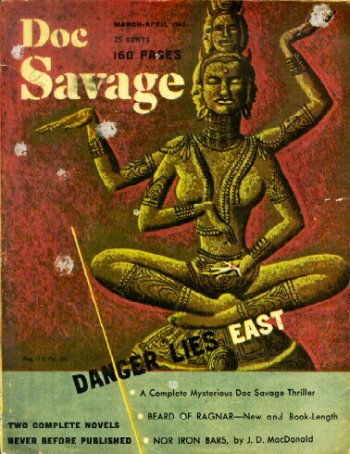
"Nor Iron Bars"

"Nor Iron Bars" is not John D MacDonald's tribute to an obscure Seventeenth Century English poet. It's not a story about love, nor is it really a story about imprisonment. This early 1947 work, which appeared in the March/April issue of Doc Savage magazine, is a story about fear. To be more precise, it's about controlling "the fear demons of the mind," and in "Nor Iron Bars" that mind belongs to Sheriff Commer, a lone figure guarding a Black prisoner from a would-be lynch mob gathering outside his office. It's an unusual setting and situation for MacDonald, who at the time had not been an author for a full year yet. It's illustrative of the wide variety of subjects he tackled early on and may have echoes to the kinds of stories he attempted in that famous 800,000-word period of apprenticeship.

Sheriff Commer is a big man, "huge, ponderous and powerful," yet the "independent nervelessness" of his body belies a "mad haze of fear" that constantly threatens to undermine him. He is able to mask that fear and go about his duties as the chief law enforcement officer of a small, Southern city.

"He kept safely tucked back on a secret shelf of his mind the thought that one day the body would break, the frenzied mind would have its way; and he would collapse into a quivering hulk, moaning over the imminence of pain and death."
 
He has a lot to be afraid of at the moment. A murder has been committed and a Black man has been arrested and accused of the crime. This being The South, and this being 1947, it can only mean one thing: a lynch mob is forming outside and it's getting angrier by the minute. Commer is the only officer in the office and the only person between the mob and his prisoner.

"He rose slowly to his feet, walked over to the window, stood and looked out into the park, saw dimly the shifting, growing crowd, heard the increased roar as they saw his bulky silhouette against the office light. He half-sneered as he realized who they must be: The drug-store commandos. The pool room Lotharios. The city's amateur Cagneys."
 
But with his fear "an ember threatening to ignite the ready tinder of his mind," Commer gets an idea, certainly unusual and probably illegal. He goes to the gun locker and pulls out a submachine gun and two drums of shells. He walks back to the jail cell, where an obviously frightened prisoner cowers against the wall. He too hears the crowd outside, and the sight of the sheriff carrying a gun is not comforting. But Commer reassures him as only a good old boy Southerner can do: "Got a feeling you didn't do it, Burton," he says. "You look like a good boy to me."

Commer gets Burton's promise that he won't escape, then gives him the gun. Commer will leave the cell door open and will head down the street for a cup of coffee. If anyone from the mob outside comes down the hall toward the cell, Burton is to fire a couple of rounds into the ceiling. If they keep coming, then a few into the floor. If that doesn't stop them, he can shoot them in the legs. Then Commer turns and heads outside. Facing the angry, shouting mob, he quiets them down and then says "You can come in after him right now..."

In 1947 lynchings were still a real problem in postwar America and MacDonald may have been inspired to write this tale by a notorious incident that took place in Georgia the year before. There, on a bridge sixty miles east of Atlanta two African American couples were stopped, tied up to a nearby tree and shot over sixty times at close range. One of the victims was a World War II veteran who had fought for five years in the Pacific. The murders sparked a national outrage and was indirectly responsible for President Truman creating the President's Commission on Civil Rights. Despite a six-month FBI investigation no one was ever accused or brought to trial for the crime.

Or, this may simply have been MacDonald's depiction of fear in a man who otherwise appears brave and unflappable. There are very, very few negative portraits of police or other law enforcement personnel in JDM's work, and he typically shows them in a favorable light being the professionals they are. Yet he does acknowledge their humanity and their weaknesses, and with Sheriff Commer he digs deeply into a psyche that is always one step away from tumbling off into the deep end.

Like much of MacDonald's very early work, his style seems a bit "off" as the author was finding his own unique voice. Still, there are lots of recognizable bits of JDM scattered throughout and the story is well done and enjoyable. It was anthologized at least once, in a 2001 collection called A Century of Great Suspense Stories, edited by Jeffrey Deaver. Deaver was himself an author of suspense novels and wrote The Bone Collector, which was later made into a feature film. He writes a nice little preface to "Nor Iron Bars" where he champions JDM's early novels over his more popular Travis McGee series, and refers to MacDonald as "the greatest storyteller of his time." He also misnames MacDonald's novel Murder in the Wind as "Murdering the Wind," but that's forgivable since he did bring this otherwise-obscure little tale to light.

The book is out of print but easy to locate used.