Tuesday, January 19, 2010

JDM on Television, Part 1

Trying to put together a definitive listing of all of the John D MacDonald-based television episodes and made-for TV movies is something I began back in 1980 when I first started corresponding with Walter Shine. In those pre-Internet days, I had only my proximity to the Library of Congress and a youthful willingness to spend long hours looking through endless lists of television episodes. I eventually gave up. I suppose a trip to the JDM Collection in Gainesville would be the most authoritative way to finalize this, and I hope to get there one day. Until then, here's what I have. The IMDb contains the most complete listing to date, but is has several errors and omissions that I am attempting to correct.

1. "A Child is Crying"

Broadcast on June 19, 1950 as an episode of the anthology series Lights Out. Based on the short story of the same name, published in the December 1948 issue of Thrilling Wonder Stories. Adapted by Ernest Kinoy.

Starring Leslie Nielsen as John Folmer and David Cole as Billy Massner

Lights Out was, of course, the television version of the iconic dramatic radio show created by Willis Cooper and made famous by Arch Obler. The television series started as a four-episode experiment in 1946, then began a regular run in the summer of 1949, continuing for three full seasons until 1952. Although Lights Out was a horror show -- a field MacDonald rarely, if ever, experimented with -- they did run occasional science fiction episodes, and "A Child is Crying" was one of those. It appeared as the series' 41st episode of its first full season. The show was shot in New York and broadcast live there, but shown via kinescope to the rest of the country. Only a few episodes of this series seem to have survived, and "A Child is Crying," unfortunately, does not appear to be one of them.


2. "A Child is Crying"


Broadcast on August 17, 1951 as an episode of the anthology series Tales of Tomorrow. Based in the short story of the same name, published in the December 1948 issue of Thrilling Wonder Stories. Adapted by Alvin Sapinsley.

Starring Bert Lytell as Dr. Hardensteen and Robin Morgan as Lily Massner

A different adaptation -- the gender of the child was changed -- and one that can still be seen today. Tales of Tomorrow was another early science fiction anthology series that lasted a couple of seasons, from 1951 to 1953. "A Child is Crying" was the show's fourth episode. I wrote about this adaptation in an earlier posting here. It contains a link to a site where the episode can be viewed.

3. "Susceptibility"

Broadcast on November 25, 1951 as an episode of the anthology series Out There. Based on the short story of the same name, published in the January 1951 issue of Galaxy Science Fiction. Adapted by David Shaw.

Starring Leslie Nielsen as Sean Malloy and Bethel Leslie as Deen Thomason

Out There was a science fiction anthology series that had a brief half-season run before being cancelled. The series began in October 1951 and broadcast its last episode in January of the next year. A list of the episode titles reveal some iconic s-f stories and writers of the era, including Robert Heinlein's "The Green Hills of Earth" and "Misfit," Ray Bradbury's "The Man," and Theodore Sturgeon's "Mewhu's Jet." It was a live/kinescope production that apparently suffered from its timeslot on Sunday afternoon, and no episodes of the show seem to have survived.

I wonder if actor Leslie Nielsen realized he was starring in his second JDM adaptation...

4. "Betrayed"

Broadcast on March 2, 1953 as an episode of Robert Montgomery Presents. Based on the short story of the same name, published in the March 1952 issue of The American Magazine. Adapted by ?

Starring Joanne Dru as Francie Aintrell and Jane Wyatt as Betty Jackson.

MacDonald's first mystery to be adapted for television, it was also the first hour-long JDM episode. Robert Montgomery Presents was an eclectic dramatic anthology series that ran from 1950 to 1957. They did everything from straight dramatic productions of famous novels ("Arrowsmith," "The Citadel") to popular mysteries ("The Big Sleep" and "Ride the Pink Horse") to musical comedy ("Rio Rita"). The dramatization of "Betrayed" was done as part of the show's fourth season, and I've written a blog posting about the story that can be read here. It does not appear that a copy of this show has survived, and I'm only guessing about the casting above, surmising that the older actress (Wyatt) played the older character.

5. "Who's the Blonde?"

Broadcast on April 26, 1955 as an episode of Schlitz Playhouse of Stars. Based on the short story of the same name, published in the August 9, 1952 issue of Collier's. Adapted by ?

Starring Don Taylor as Tom Weldon, Maxine Cooper as Helen Weldon, and Joi Lansing as "The Blonde"

Sponsored by the famous beer company, Schlitz Playhouse of Stars lasted eight seasons on television, from 1952 to 1959. Beginning as an hour-long live broadcast, it was cut to 30-minute episodes and done on film by the time "Who's the Blonde?" was broadcast. The show went through a series of different hosts, with James Mason serving in that role in 1955. About 60 episodes of this show have survived, but "Who's the Blonde?" is not one of them.

"Who's the Blonde?" is a neat little story that would have fit perfectly on Alfred Hitchcock Presents.

To be continued...

Monday, January 18, 2010

"Begin Again"


When John D MacDonald was twelve, he became severely ill. What began as a case of scarlet fever developed into mastoiditis, which was a leading cause of child mortality in the days before antibiotics. He was bedridden for a full year, and it was there that he developed his love for books, at first with his mother reading to him, later reading on his own. It was a life-changing experience, and it turned an average boy into an introverted bookworm. "I entertained myself by exercise of imagination," he recalled later.

That experience is almost certainly the inspiration for "Begin Again," a brief short story he wrote in 1947. It was published in the November issue of Liberty magazine that year and is one of his earliest mainstream pieces to see print. A poignant, bittersweet tale of merely 1,800 words, it draws not only on his childhood illness for inspiration, but also on the cold and distant relationship he had with his father.

Young Robert is confined to his bed for something more serious than mastoiditis: he has contracted polio, an illness that is never specifically spelled out but is obvious nonetheless. He adapts to life in bed rather easily. "It wasn't hard, really... every day was long, but not too long, when you learned how to make little things last." Robert's daily highlight is the moment his father comes home, when dad comes into his room before dinner and asks how he is doing, joking and laughing with him. One day he comes home with "a big board, wax paper, some glass cement, and two boxes of kitchen matches with the heads removed." Robert can now fill his day building a fort, complete with walls, windows and buildings inside. This, his father explains, is something his own father did with him when he was sick in bed. Robert will work on it during the day and when dad comes home, they will work together before dinner. "Then, when you're well," the father explains "we'll take the whole works out into the back yard and be Indians setting fire to the fort. You ought to see one burn!"
Robert is ecstatic and works feverishly on the project.

When it is time for Robert to be fitted with a leg brace, MacDonald writes some beautiful third-person subjective prose:

"He was shy about his leg, it looked so awfully thin, like one of the matches, but they didn't seem to notice how thin it was. They made measurements and came back two days later and fitted the brace to the thin leg, telling his mother something about 'Merely the problem of getting used to it' ... When his father saw the shiny brace of metal and leather and padding, he got a funny tight expression around his nose and mouth, as though he were about to sneeze."


The work on the fort continues, with Robert painting the walls and adding grass, even cutting windowpanes out of wax paper. Then one day his father comes home and joyfully announces, "Kid, it looks like today's the day." It changes everything.

MacDonald's mainstream fiction -- at least in the short form -- has been virtually ignored by every one of his biographers. Both Hugh Merrill and Ed Hirshberg mention it only in passing, and it was rarely discussed even in the pages of the JDM Bibliophile, a journal dedicated to the author's work. It's a shame, because some of that work, not just the stories MacDonald included in End of the Tiger and S*E*V*E*N, are stunning. "Begin Again" is beautifully written and deserves an audience.

At least the editors of Liberty liked it. They included it in a 1966 paperback anthology titled Famous Short Short Stories, and dug it up for the Winter 1973 issue of their "nostalgia version" of the periodical, Liberty Then and Now Magazine. It was also reprinted in the February 1969 issue of Pageant magazine.

Anyone wishing to read the story can do so -- for free -- via Google Books, by clicking here.


Friday, January 15, 2010

JDM on Film

Since there doesn't seem to be a 100% complete or error-free list of John D MacDonald's works on film and television, I thought I'd post those I know of. Since MacDonald was rarely done well on either screen, it is, perhaps, not surprising that a reliable listing hasn't been put together. I've seen stuff in print and on the web, but everything has something missing. Even the IMDb, to which I have submitted numerous additions and corrections, has several errors and omissions they seem incapable of correcting. I'll break this up between theatrical releases and television adaptations, beginning with the easy one, film. Television will follow sometime next week.


1. MAN TRAP (1961) Directed by Edmond O'Brien, starring Jeffrey Hunter, David Jansen and Stella Stevens. Based on the novella "Taint of the Tiger" which was published in the March 1958 issue of Cosmopolitan. It appeared in book form in August of that year under the title Soft Touch.

Producer Stanley Frazen purchased the film rights after reading the novella in the Cosmo. He still recalls the film fondly, stating in 2009 "It was a great heist caper with a terrific performance by Janssen." He is in a definite minority, as I have never heard of anyone else feeling warmly about this hash of an adaptation. The New York Times Guide to Movies on TV called it a "a second-rate melodrama, derived from a typical, brass-knuckled John D. MacDonald crime yarn that read better and certainly moved faster." In 1984 MacDonald told Ed Gorman "I think I would have a warmer feeling about Soft Touch had it not been made into a pretty sorry motion picture called MAN TRAP." That remark implies he actually saw the film, which is belied by a 1986 TV Guide article he wrote titled "The Movies of My Books? Listless, Dumb, Inept." "A friend advised me not to see it," he wrote of the film, "but I would have, had it been shown anywhere handy. Another friend saw it listed on a billboard in Kentucky as the third feature in a midnight drive-in fiesta."

I saw MAN TRAP once about 30 years ago and remember it as being utterly boring. According to the IMDb, it was actor Edmond O'Brien's first solo effort at directing a feature-length film, and it shows. Stella Stevens would go on to a better JDM screen adaptation in the 1973 Made-For-TV version of LINDA.

2. CAPE FEAR (1962) Directed by J. Lee Thompson, starring Gregory Peck, Robert Mitchum and Polly Bergen. Based on the novel The Executioners, published in April 1958.

Peck purchased the film rights to the novel after reading it and decided to both produce and star in the film. He formed his own production company, along with co-star Mitchum (Melville-Talbot Productions) and hired James R. Webb, a screen writer of primarily westerns to do the adaptation. Director J. Lee Thompson had just directed Peck in The Guns of Navarone. According to MacDonald's biographer Hugh Merrill, Peck originally wanted Telly Savalas to play Max Cady but was overruled by the film's backers because Savalas lacked the box office power. He settled for a smaller role as a private detective. The film was moderately faithful to its source, adding a few new characters and completely changing the location and action of the ending, moving it from the Bowden's home to the Cape Fear River.

Often touted as the best adaptation of a MacDonald work, the author himself apparently didn't think much of the end result, referring to it as a "dreary moving, I mean unmoving, picture." He later wrote "Artistically the movie warped the concept of the novel -- which was that no matter how threatened you might feel, you don't get police protection until you have been hurt." He was more involved with this effort, attending the Florida premier and making several publicity appearances. "I stood on those stages," he said, "and said it was a fine movie. When they asked if I had someone like Barrie Chase in mind, I said 'Sure.' But she wasn't in my book. She had been written into the script."

The film is best known -- rightly so -- for Mitchum's iconic performance as Max Cady, MacDonald's archetypal soulless villain. He is truly frightening to behold. According to MacDonald, he took on the part with great relish, going as far as to do a bit of his own wardrobe, purchasing that cheap, distinctive hat for a dollar in a local second-hand shop.


3. DARKER THAN AMBER (1970) Directed by Robert Clouse, starring Rod Taylor as Travis McGee and Theodore Bikel as Meyer, with Suzy Kendall and Jane Russell. Based on the novel Darker Than Amber, published in June 1966.

The first attempt to film a Travis McGee novel, DARKER THAN AMBER was not well received at the time but tends to look better as the years roll on. MacDonald fought for years to keep McGee off the screens of both film and television. At one point in 1965 Goodson and Todman proposed a TV series starring Chuck Conners as McGee, and waived huge amounts of money in MacDonald's face, only to be told that McGee wasn't for sale at any price. But the author was much more receptive to the idea of putting McGee on the big screen. In 1966 he signed a deal with Major Productions Corporation to film a McGee movie every eighteen months, with MacDonald's cut significantly larger with each succeeding film.

For years MacDonald had harbored the idea of having actor Jack Lord play McGee, having first seen him in the television series Stoney Burke. MacDonald believed he "had all the right moves" and "had the look of a sailor." Lord apparently expressed an interest in playing McGee, but in 1968 he was cast in the long-running television series Hawaii Five-O, which was filmed in Hawaii and occupied most of the shooting year. (It has also been told that MacDonald's wife Dorothy thought little of Lord's acting ability, once telling her husband, "John, all he does is act with his teeth!")

Once AMBER had been chosen to begin the "series" and the project was given the go-ahead, the search for McGee began. Many names were considered and many actors coveted the part, including Robert Mitchum, Steve McQueen and Vic Morrow. The producers of AMBER very nearly signed Robert Culp for the part, but the deal fell through, much to MacDonald's relief ("Culp was a disaster," JDM wrote. "No comprehension of the touch needed. Glad he will not be McGee... too wispy and elegant") Ultimately Australian actor Rod Taylor was cast. MacDonald was initially unhappy with the choice, but after visiting the set and meeting Taylor, he grew to accept the casting ("...he understands what McGee is all about," wrote the author, "...the anti-hero, tender and tough, with many chinks in the armor.") He was ecstatic over the casting of Theodore Bikel as Meyer ("Bikel is Meyer," said MacDonald), but was less happy with the script and battled for months over its final form.

The final result was not well received, and the film was a flop, effectively burying the series idea. A reviewer for the Chicago Tribune wrote that the film was "feral, cheap, rotten, gratuitously meretricious, shallow and embarrassing," leaving little doubt as to where he stood. MacDonald regretted ever having sold the rights, vowing never to do so again (the rights reverted back to him once a second film was axed), but that was to prove, unfortunately, a false vow.

Years later, MacDonald's memories of the film had soured considerably. "I had an advance look at the script and thought it dreadful. I rewrote the first 30 pages as a gift [but it] was ignored. I hated the way they turned Meyer, a fine fellow, into a fat dumb clown." He concluded the filmmakers' efforts had been totally inept.

Seeing the film again a few years ago, it didn't seem as bad as it was made out to be, outside of the cheap film stock that seems to be the hallmark of most films made in the 1970's. Taylor comes close, and Bikel is OK, but the script is a mess, having McGee pine over the departed Vangie, despite the fact that she was part of a murder ring. As Lewis D. Moore wrote, " [It] makes a disappointing moral hash of the novel."

Still, it looks like a Bond film compared to the next McGee adaptation, which (mercifully) was limited to television.


4. A FLASH OF GREEN (1984) Directed by Victor Nunez, starring Ed Harris, Richard Jordan and Blair Brown. Based on the novel A Flash of Green published in 1962.

It took an independent filmmaker with very limited experience to finally bring John D MacDonald convincingly to the big screen. A FLASH OF GREEN is far and away, the best film version of anything JDM ever wrote. With a budget of just $1 million, Victor Nunez directed, wrote the screenplay and handled the cinematography. He beautifully captured both MacDonald's voice and the Florida of the early Sixties. The novel is a thinly disguised retelling of a real-life developer's attempt to fill in Sarasota Bay, and it holds a special place in the hearts of MacDonald aficionados. (Jim Harrison, writing in the New York Times Book Review in 1975, called it "the first and best of all novels with an ecological base...") Actor Ed Harris had just achieved stardom in The Right Stuff the year before, but had signed on to GREEN before that, otherwise Nunez would not have been able to afford him. Richard Jordon, who played villain Elmo Bliss, had been a longtime fan of the novel and was instrumental in getting the financing put together; he also served as the film's producer. MacDonald himself was a backer, contributing $30,000 after attending a screening of Nunez's first film, GAL YOUNG 'UN. GREEN was shot on Casey Key, where the MacDonald's had once lived from 1951 to 1952.

American Playhouse, a PBS anthology show of the time, was also a backer, which allowed it to air the film on television after its general theatrical release. They were forced to do a tiny bit of editing, cutting only a brief glimpse of Blair Brown's breast. The film was shown at the Cannes Film Festival and was nominated for the Grand Jury Prize, but lost out to the Coen Brothers' Blood Simple. It had a general release, against MacDonald's wishes (he wanted it limited to art houses) and was favorably -- if unenthusiastically -- reviewed. Vincent Canby, writing in the New York Times, was typical, calling it "...not perfect, [but] provocative and nearly always intelligent."

In the 1986 TV Guide article, MacDonald complained that a poor distribution plan robbed the film of any chance of success. Still, he loved the film, writing:

"Through some special magic Victor Nunez captured the flavor and pace and ambience of my novel, and the scenes of anger and indignation and frustration are very close to what was happening in my head when I was writing the novel 24 years ago. Even the color tones of Florida sunlight and shade are reproduced with an uncanny exactitude...Damn it, the movie does move slowly -- because it is supposed to. It fits the style and mood of my novel better than I had believed any movie could.... the long wait was worth it."

5. CAPE FEAR (1991) Directed by Martin Scorsese, starring Robert DeNero, Nick Nolte and Jessica Lange. Based primarily on the previous film version, but using some of The Executioners.

This remake was originally to have been directed by Steven Spielberg, who ultimately turned it down and offered it to Scorsese. Scorsese was initially skeptical and had little interest in the project -- in fact, he showed open disdain for the original novel. He ordered many, many rewrites, until a satisfactory script was written. Unfortunately, by that time, the script had nothing to do with the MacDonald original, save the bare-bones outline of the plot.

If MacDonald thought the original film version of The Executioners was "a warped concept of the novel," he must have been spinning in his grave over this remake. His story of the inability of the legal system to protect its citizens becomes an overwhelming, nearly operatic tale of retribution, a world where the protagonists are nearly as guilty as the villain. Instead of being a witness to Cady's original crime of rape, Sam Bowden is now Cady's original defense attorney, one who willfully withheld evidence that would have exonerated his client. The Bowden family is changed from a typical middle-class representation of the average citizen into a group of amoral sinners, each worse than the next. Sam, in addition to his prior questionable legal tactics, is an adulterer who has had to move his family to another state because of a prior indiscretion, and who may now be indulging in another. His wife is a cynical, chronic nag who chain-smokes, and their daughter is just plain creepy, a slack-jawed semi-literate who longs for Cady to rape her. All of this may be material worthy of exploration, but it has absolutely nothing to do with John D MacDonald.

The climax of The Executioners takes place at the Bowden home, and that scene -- eliminated in the first film -- is retained, prior to the real climax, a CGI-enabled chase on the Cape Fear River taken from the first film. Scorsese used three actors from the original film -- Peck, Mitchum and Martin Balsam -- in bit roles, and used Bernard Herrmann's score from the original, adapted by Elmer Bernstein.

Wednesday, January 13, 2010

Knox Burger, Agent and Book Editor, Dies at 87

The man responsible for persuading John D MacDonald to create Travis McGee is dead. He was the fiction editor at Collier's when "Looie Follows Me" was published and he later became editor-in-chief at Fawcett, the publisher that put out most of JDM's paperback originals.

If you love the works of MacDonald, or popular fiction in the Twentieth Century, he was a giant.

You can read his obituary here.

Knox Burger, Agent and Book Editor, Dies at 87

"Woodchuck"


John D MacDonald wrote short fiction primarily for publication in magazines, mostly pulp fiction periodicals but also for mainstream "slicks." On very rare occasion he wrote original stories for publication in anthologies, such as Future Tense in 1951 and Who Done It? in 1980. In 1971 he published his own anthology -- the second -- and called it S*E*V*E*N, complete with the asterisks between the letters. In addition to reprinting four of the five stories he had sold to Playboy in the late Sixties, it contained three originals that had never before seen print. The paperback appeared with little fanfare and contained no introduction. It turned out to be the only John D MacDonald book to be published that year.

The stories are of the mainstream variety, with the exception of "The Annex," -- JDM's last effort at science fiction -- and they are surprisingly adult, especially "Woodchuck," one of the three originals. That story concerns a successful middle-aged businessman who treats women like hunted prey and trophies, although not in the literal sense, thank goodness. The woodchuck of the title is the focal point of a childhood memory he has, a metaphor for his need for sexual conquest and one that he feels can explain his motivation.

Aldo Bellinger is a successful real estate developer, long divorced and in charge of his own small company. He is involved in a sporadic sexual relationship with his personal secretary Anne Faxton, who has been in his employ for seven years, and his bedmate for four. As the story begins Aldo is recalling their first sexual encounter, a magical "Metro-Goldwin-Mayer prefabricated romance," that turned into an intense sexual experience:

"He had found himself tapping an entirely unexpected store of sexual energy, and vitality in that narrow, brunette, small-breasted body. Wiry, limber and demanding. Strong demands create strong responses. So it had been a lot better than very good."

Aldo has come to rely on Anne, both for her precise, unsentimental business sense as well as for her physical companionship. But not enough to stop something that Anne can see coming a mile away. Aldo's other employee is Lee Roundtree, a young man in charge of marketing Aldo's new real estate venture and who is married to a very attractive young woman. As we get to know Aldo the reader comes to realize that he is, at first, not a very nice guy and, later, a genius at manipulative psychology. Without even admitting it to himself, he has planned a trip for Lee that will leave his wife Liz alone in the hotel where they and Aldo and Anne are staying. But Anne can sense it and begs him to leave off, not for the sake of their relationship, but for the happiness of Lee and Liz. She begins to fret that Aldo lacks mercy, so to prove to himself whether or not he is capable of this virtue, Anne suggests he should, once he knows he is able to bed Liz, to walk away. He says he'll consider it.

He does, for about ten seconds before going ahead with what he had planned in the first place. Afterward he worries how Anne will react. He feels he could get her to understand if he could tell her the story of his grandfather and the woodchuck, an incident that happened to him when he was seven years old.

MacDonald does an expert job of developing the character of Aldo Bellinger, slowly revealing pieces about him as the story progresses. While not exactly an unreliable narrator (the story is told in the third person) we do end the story with a far different picture of the character than when we started, and Aldo's justifications for his actions slowly peel away that unreliable picture until the real person is revealed. He clings to the woodchuck incident as both motivation and justification for who he is, and he longs to tell Anne, who he really believes he has feelings for.

The sex in "Woodchuck," while tame even by the standards of 1971, is fairly graphic for MacDonald. In a story about a man who uses sex as a weapon, I guess it needed to be, although I wonder how comfortable the author was in writing it. The fact that this story was never published in a periodical (even Playboy!) might say something about that. Still, it wouldn't even get an "R" Rating today.

The woodchuck story flashback was, apparently, based on a real-life incident in MacDonald's childhood, and the description of the grandfather -- barring the missing hand -- is a perfect physical match for Pa Dann. According to Walter Shine in the JDM Bibliophile 22, MacDonald recounted the real-life tale to a fellow author in a 1959 letter, and it was "in essence exactly the way it later appeared" in the story.

Tuesday, January 12, 2010

Dead Low Tide

Dead Low Tide is John D MacDonald's first great novel.

Published in May 1953, it was his seventh book, his fifth paperback original, and his first non-science fiction work to receive contemporaneous reviews in the press of the day. Highly regarded by mystery writers such as Ed Gorman and editors Brazun and Taylor (A Catalogue of Crime), it takes the still-unformed template of middle-class-man-confronts-crime and perfects it. The novel is just as thrilling a read today as it must have been 56 years ago, its characters sharply and realistically drawn, its plot masterfully constructed, and its depiction of time and place (Florida) worthy of a first-rate historian. I remember reading the book for the first time back in 1975 and being struck -- I was reading the novels in chronological order -- at how quickly MacDonald had settled into the form that was to serve him so well and for so many years. Like the novel that preceded it (The Damned) it is a major leap forward in the author's progression as a craftsman.

Not coincidentally, it's also MacDonald's first confrontation with absolute evil, that "blackness for its own sake," in the form of a villain that was to become a hallmark of his writing. It would reach its perfection five years later in the person of Max Cady in The Executioners, but Roy Kenny in Dead Low Tide is no less diabolical or focused in his evil. He just has an excuse (sort of), something MacDonald would later dispense with as completely unnecessary. But even though JDM felt the need to offer an explanation, the fear that evil evokes is just as real.

The story takes place near Sarasota on fictional Horseshoe Key, at a time of great land development. Twenty-eight year old Andy McClintock is a typical JDM hero, a hardworking professional and a business administration graduate from Syracuse University (as was the author), looking to make an honest living and not hurt anyone in the process. For the past year he's been employed as a construction estimator with John Long Contractors, a small real estate development firm, and he seems to be going nowhere. "I'd started in the office, answering the phone and typing on two fingers. A year of it and I still answered the phone, typed on four fingers, and made estimates and chased materials and got twenty bucks more a week than a year ago." Andy is working late one hot night when he's paid an unexpected visit by the wife of his boss, Mary Eleanor Long. "She is one of those dark-haired Alabama girls, a kind of stringy little girl, dark, and if you look closely, feature by feature, you can see that she is not pretty. But her face is so alive all the time that afterward you would swear she is pretty." She's worried about her husband John, who is acting strangely and keeping secrets. She asks Andy if he would be a dear and try and find out for her what the problem is. Although not too happy with the request, he's afraid to say no. He accepts a ride home from her, with a quick stop at a roadside tavern along the way.

Home for Andy is a small cabin in a secluded part of town, one of ten "little bastard-Spanish houses" that make up what once was a bay front resort and has now become permanent living for the struggling working class. He's greeted by neighbor Christy Hallowell, a friend and onetime paramour, who is up late sitting on his front steps. Christy came to Florida following an ugly divorce, and she and Andy had a brief affair that ended after they realized "there was more profit to both of [them] in friendship than in love..." although it is obvious that something is still smoldering just below the surface. Christy is described in classic MacDonald fashion:

"She's a big brown slim-wasted blonde with a sturdy frame, extra-long legs, a face a bit too round for beauty, with the eyes being the best part. Eyes the shade of wine vinegar... She is a Midwest blonde and she is something they seem to be growing out there these last few years. Big girls who look smooth and tight and well fitted into their skin. Out there when three of them come down the sidewalk abreast there is something overpowering about them, and you feel that your masculine ego is being hemmed in by a thicket of long, long legs. And they all seem to have an odd, casual lack of any physical self-consciousness. Their splendid bodies are not something to be aware of. Just something they want to keep clean, tanned and at the proper temperature."

The two of them share a snack and Andy tells Christy about his strange encounter with the boss's wife.

The following day Andy drives out to Key Estates, the big bay front housing development being built by his company. There he finds John Long and makes a ham-fisted attempt to pry, ending in him tendering his resignation. He's taken by surprise when Long offers him a promotion and talks as if he won't be around for long. Andy assumes he has some sort of terminal illness and wants the project in the hands of someone who can finish it. He promises to hire Andy a secretary and gives him a raise.

Andy's visit to the construction project is also MacDonald's excuse to launch into his first great "aside" on the despoiling of his adopted state. Remember, this is three years before Murder in the Wind, 20 years before Travis McGee took a plane ride over West Florida in The Turquoise Lament, and 23 years before it all came crashing down in Condominium:

"Florida, particularly along the west coast, all the way from Cedar Keys to the careful monied smell if Naples, is constantly growing -- not in the normal fashion of other places, with more houses going up on existing land, but the land itself is growing. Shaggy dredges park in the bay flats, snarling and wheezing as they suck up mud and guck and shells and small unwary fish. The debris is piled moistly and it stinks for a time, then whitens in the sun. It is leveled and stamped down and then houses go up on it so fast they seem to appear with a small clinking sound -- the way Walt Disney grows flowers.

"People who bought water-front land and admired their view of the bay find themselves three blocks inland. Incantations are said, in which strange words appear. Riparian rights is a good word. It sounds stentorian and nobody knows exactly what it means. It means turning water into land and putting houses on it. And standard procedure, along with the houses, is to stuff some palm trees into the made land. They have a nasty habit of taking a long time to die, so you can usually sell the house before the palm turns to a rich tobacco brown. Also, you have to have a sea wall, or the bay will reclaim its own. And you put about seven-eights of an inch of topsoil on the shells and plant rye grass. And a hedge of Australian pine that grows so fast you can hear it.

"And you pray, every night, that the big one doesn't come this year. A big one stomped and churned around Cedar Key a couple of years back, and took a mild pass at Clearwater and huffed itself out. One year it is going to show up, walking out of the Gulf and up the coast, like a big red top walking across the schoolyard. And the wind isn't going to mess things up too much, because people have learned what to do about the wind. But that water is going to have real fun with the made land, with the sea walls and packed shells and the thin topsoil. It's going to be like taking a good kick at an anthill, and then the local segment of that peculiar aberration called the human race is going to pick itself up, whistle for the dredges, and start it all over again."

Andy calls Mary Eleanor to report his findings, but she insists on coming out to his place late that night to hear it in person. She doesn't take the bad news quite the way Andy expected, and as she is leaving he senses a strong animal magnetism emanating from her: "...she had that weird knack of making you overly aware of her femininity, aware of a thin urgency in her body, a sort of prehensile inventiveness. I had the crazy feeling that I could kiss her once, pick her up and carry her -- burning in my arms -- right back into the house."

He doesn't.

The following evening he comes home and surprises an unseen intruder who is able to escape into the night. The only thing he can see that is missing is a harpoon gun he had hanging in the garage. Probably some kid.

The next morning, however, John Long is found dead out at Key Estates, and the harpoon is sticking in his throat. The police initially surmise he killed himself, but eventually decide it was murder, and once the harpoon is discovered to be Andy's, he is jailed and charged with the crime. In addition to owning the murder weapon, he's been seen out late with Long's wife, and there's a contract hastily drawn up leaving John Long Contractors to Andy. Add to that, Mary Eleanor is claiming that she and Andy were having an affair. Andy's been set up, and he knows it. Stuck behind bars, he asks Christy to "pry around" in order to get some information to clear him. Things don't turn out well for Christy, and Andy is freed to begin his own hunt for a murderer.

In The Black Lizard Anthology of Crime Fiction (1987) editor Ed Gorman wrote about Dead Low Tide in the Introduction: "... anybody who wants to write mysteries should buy a copy of Dead Low Tide and memorize it,” he said. “It is without flaw and filled with sensational observations about America circa 1953." I don't know about the book being without flaw -- there is one glaring coincidence that sticks out and is nearly apologized for at the end -- but Gorman is certainly correct about the observations. Here are a few:

"[It] was a frame house that looked as if it had been picked up bodily out of some small Indiana town in 1914 and moved to Florida. Two stories and two stunted gables, and a deep front porch with rocking chairs, and brick front steps. That happens sometimes. People retire, and distrust the unfamiliar. So they come down here and duplicate the awkward living they have endured during all the years of working and saving. Tired boxlike rooms and overstuffed furniture with crocheted dinguses on the backs and arms of the chairs. Ferns in pots, and two floors and an attic. There is a way to live in Florida -- a way of turning a house inside out, so there is no real transition between outdoors and indoors. Glass and vistas and the good breeze coming through... But they come down and build their high-shouldered houses with the tiny windows, and thus what should be a good life turns into one long almost unbearable summer in Indiana."

"I tip-toed... down the creaking Indiana stairs and across the lemonade porch and back into Florida, out of the world of knitted things, and out of that sweet warm horror that Bradbury seems to know so well."

"There can be beauty in the coupling of man and woman, but only in the hearts and souls of the participants. It is not, as one can understand, a spectator sport. We are the hairless beasts, and in our spermatic strainings there is, from a spectator standpoint, only that sort of curious interest felt by men with big bellies and tiny minds -- the men who attend smokers and compensate thus for their own nocturnal inadequacies."

"The local hospital is inadequate. It seems as if everybody and his brother have been moving to Florida and bringing the kids. It's getting so you have to line up for everything. Schools, roads, lunch, room to fish off a bridge. It shocks you a little when you go inland about five miles and find it looking as though Señor de Leon hadn't taken his trip yet."

"I guess every state in the country is infected with them -- greasy-spoon restaurants on the fringe of town. Red imitation leather, badly cracked, on the counter stools. Weary pie behind glass. A stink of frying grease in front, and tired garbage in back. Sway-backed, heavy-haunched waitresses with metallic hair, puffed ankles, and a perennial snarl. A decent toss of one of the water glasses would fell a steer. A jukebox and plastic booths and today's special is chicken croquettes with fr. fr. pot. and st. beans -- ninety-fi' cents. And the coffee is like rancid tar."

When we finally get to meet the bad guy we are introduced to a completely amoral villain. MacDonald was rarely equivocal about the nature of pure evil. He believed it existed, and didn't necessarily feel it needed to have a visible cause. Ronnie Crown, Max Cady, Junior Allen and Boo Waxwell all have their antecedents in Roy Kenny, and the paragraph describing Andy's first encounter with him will be echoed again and again in JDM's writing:

"He was almost a normal-looking guy. But he brought something strange into the now-familiar office. I know I felt it... He gave me the feeling that I was carrying excess baggage --- that I was burdened down with self-doubt, and moral conjectures and vague fragments of philosophies. He made me feel that my normal soul-confusion, all the inward turmoil of merely being a human being, was actually a bit silly -- a lessening of efficiency. He was not burdened thusly. He looked as specialized as a knife blade. He brought something chilly and alien into the office, something you felt instinctively, something he compounded by a stillness which at first I did not understand. It took me a moment to see that it was a complete lack of mannerisms, of any of the useless movements we indulge in."

As I noted above, Dead Low Tide was the first of MacDonald's paperback originals to receive notice by book critics. This could have possibly been due to the unprecedented success of his previous effort The Damned (and the original cover to Dead Low Tide certainly didn't want you to forget that) but the reason most often cited is the interest taken in MacDonald by William Anthony Parker White. Writing as H.H. Holmes in the New York Herald Tribune, he was that paper's science fiction critic and had made note of MacDonald's first hardcover release Wine of the Dreamers in 1951. White assumed a different identity for another newspaper of the day, and as Anthony Boucher he reviewed mystery novels for the New York Times. It was in the Times where Dead Low Tide was mentioned. Boucher said of the author "...[his] writing is marked by sharp observation, vivid dialogue and, to quote the author, a 'sense of sweet warm horror.'" Boucher became a champion of sorts for MacDonald's writing and reviewed nearly every subsequent book he wrote.

Dead Low Tide was also mentioned in the New York Herald Tribune, where James Sandoe said "John D MacDonald has managed here a highly readable book, thick with tensions moving in a nicely mannered plot and all of it reported with sardonic pungency."

The novel has been remembered often since it was originally published. It was singled out of all of JDM's novels in Jacques Barzun and Wendell Hertig Tailor's mammoth survey of mystery fiction, A Catalogue of Crime in 1980 ("One of his best stories of sex and violence in Florida"), and Jonathan Yardley quoted passages from it in a 1992 piece about Hurricane Andrew for the Washington Post. I've personally revisited it many times over the years and it never grows stale. As Ed Gorman suggested, it is a template for the perfect crime novel.

The setting for Dead Low Tide is fairly easy to guess, at least for anyone knowing JDM's biography. When he first moved to Florida in 1949 he and his family settled in Clearwater Beach, which, according to biographer Edgar W. Hirshberg, was "as yet unspoiled by traffic jams and high-rise hotels and condominiums." After two years there the family moved south to Casey Key, which would seem to be the inspiration for Horseshoe Key. They lived there in a rented house for a year, which, again, may have been the model for the houses Andy and Christy live in. Then, in late 1952 -- around the time MacDonald would be writing Dead Low Tide -- the family became homeowners, purchasing a home on Point Crisp Road on Siesta Key, at the end of a small bayside peninsula, a location that looks remarkably similar to Key Estates. It is more likely, however, that Key Estates was based on the houses built along Casey Cove Drive in 1952, as both the date and location fit.

Finally, an amusing bit of trivia: MacDonald's novels were translated into dozens of different languages and reprinted throughout the world, often with curious results. The McGee series, for example, when translated into Finnish, abandoned the color scheme in the titles and replaced them with the word "Dangerous" (The Deep Blue Good-By = Dangerous Glow; A Deadly Shade of Gold = Dangerous Loot). Some simply sound clumsy, such as the Dutch translation of Free Fall in Crimson (A Soft Red Landing) or the Czech title for A Purple Place for Dying (To Die in a Purple Place), but a few read like something out of an Andy Kaufman routine. The Czech version of The Drowner is called To Agree With Sharks, The Executioners became the Dutch The Night of the Maniac and the French version of Free Fall in Crimson is called Hot Balloons!, complete with the exclamation mark. The best new titles, however, seem to have been reserved for Dead Low Tide. In Dutch it is called The Beheaded Photo, in Finnish it is You Know Too Much and in Spanish it is known as Death with the Low Tide.

The Grand Prize goes to the Germans, however, who call it Moskitos stechen meistens nachts, or Mosquitoes Sting Mostly at Night.


Monday, January 11, 2010

Where is Bloodshot Rainbow?

Well, 2009 has come and gone, and the promised new John D MacDonald biography is nowhere to be seen. Schaffner Press, a small, independent publisher located in Tucson, Arizona, had been touting a new bio since early in 2008, with an expected publication date of Fall 2009. A recent check of the company's website does not look good. While the site is still up, the homepage is still advertising their Spring 2009 releases. Their last press release issued was in March of last year and the link to the MacDonald bio page is dead. I emailed them with an inquiry a few weeks ago and have yet to receive a reply. At least it didn't bounce...

Which is a shame, since it promised to be a great book, at least based on the press release below. One can only hope that if indeed the publisher has gone belly up, that James Walling can peddle the work to a different publisher. I'll stay on the look-out and report back with anything I learn.

Schaffner Press: Upcoming Releases Archives: "BLOODSHOT RAINBOW: The Life and Work of John D. MacDonald
James Walling
Fall '09
Trade Paperback

John D. MacDonald, the hugely prolific bestselling writer of crime novels whose iconic hero Travis McGee became the template for dozens of contemporary mystery writers has until this book largely escaped biographical scrutiny and literary appraisal. With research
ranging from literary archives and correspondence and information gleaned from as yet unpublished military records, author James Walling will retrace Macdonald's footsteps from his years in Burma with the OSS in WWII to his single titles bestsellers, (one of which, THE EXECUTIONERS, was the basis for the movie CAPE FEAR), to the immortal Travis McGee series and the twenty-one books in which the legendary protagonist starred, as well as the final uncompleted ' Black Book' which supposedly featured McGee's demise. In examining not only the mysteries and crime novels, longer works of fiction such as CONDOMINIUM, and even MacDonald's forays into sci-fi (THE GIRL, THE GOLD WATCH AND EVERYTHING) this book will firmly establish MacDonald in the firmament of quintessentially American literary figures, sadly underappreciated due to the commercial genres in which he chose to ply his trade."

Friday, January 8, 2010

"Trojan Horse Laugh"

John D MacDonald's experiments in science fiction occupied a relative brief period of his writing career. If we exclude two oddball tales published in 1947 ("Hole in None" in Liberty and "The Pedans Box" in Bluebook), it began in February 1948 with "Cosmetics," a short story published in Astounding Science Fiction. MacDonald would go on to write nine more s-f stories that year, 16 in 1949 and 14 in 1950 (including "Wine of the Dreamers," which later became his first s-f novel). He produced only seven in 1951, two in 1952 and a single tale in 1953, after which he was basically done with the genre. He has said he enjoyed the freedom science fiction offered, as well as the fact that it was a huge market back when short fiction filled the magazine racks of this country. As a "dabbler" in the trade, he was certainly not alone, as other early writers of s-f -- Kurt Vonnegut, John Jakes and Michael Shaara, to name a few -- later moved on into other fields of writing.
 
MacDonald published five stories in Astounding Science Fiction, one of the premier s-f pulps of the day, and one of the few that still survives. In began in 1930 under the name Astounding Stories of Super-Science and is published today as Analog Science Fiction and Fact. From 1937 to 1971 it operated under the editorship of John W. Campbell, Jr, whose influence cannot be overstated, and who was responsible for MacDonald's stories being published there.

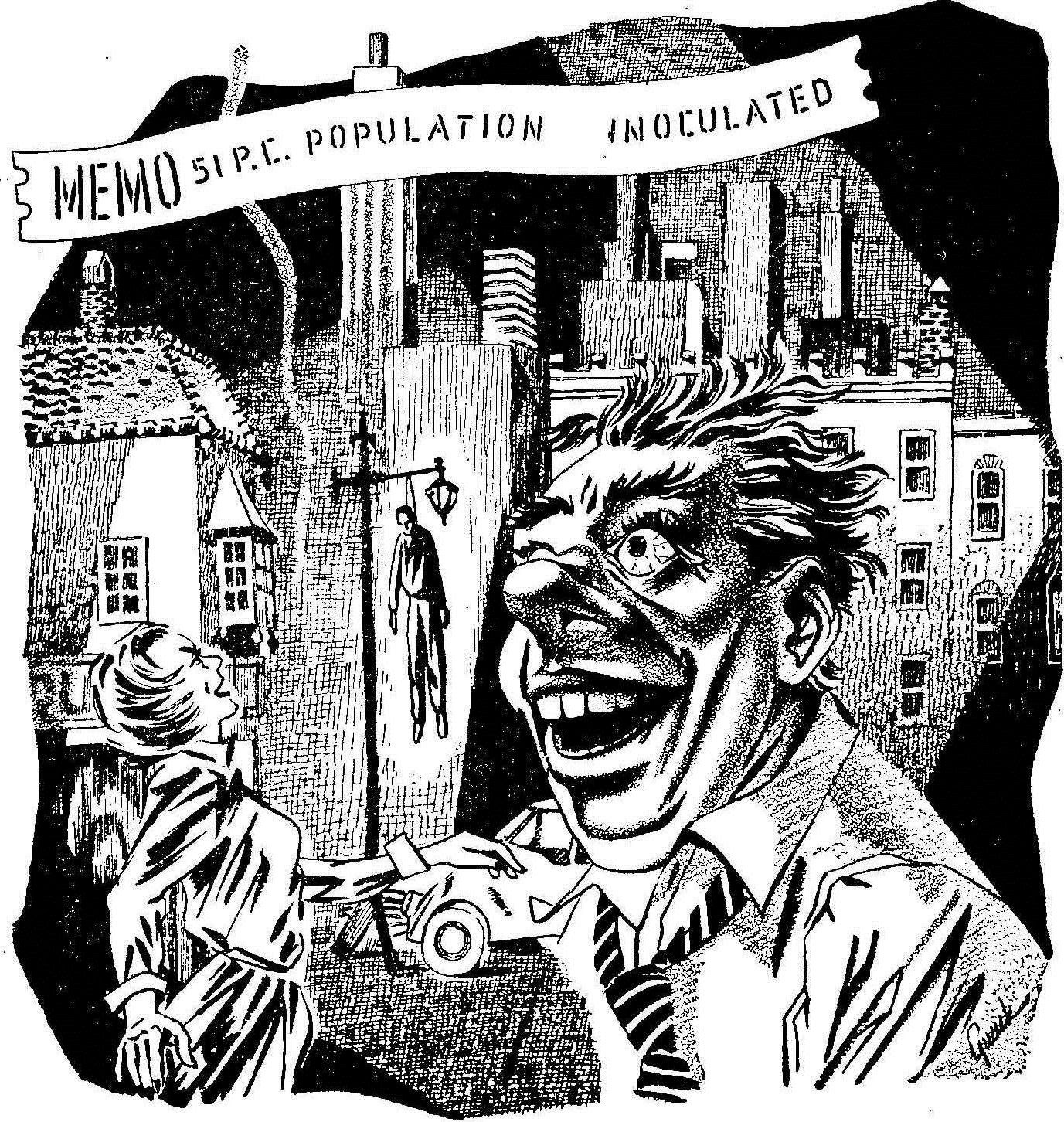
"Trojan Horse Laugh" was the fifth and final story, published in August 1949. It is an 18,000 word novella that takes place in the near future and involves science fiction only slightly. It is really an invasion story, with the invaders being humans, not aliens, from either the Soviet Union or China (it is never made clear). It is their method for invading that provides the science fiction. The story has its most obvious antecedent in Robert Heinlein's "Sixth Column," which was originally published in 1941 (in ASF) as "The Day After Tomorrow" and which was reprinted as a hardcover book in 1949. Interestingly, the original idea for "Sixth Column" came from Campbell. Also, when it was originally published in 1941 it appeared under Heinlein's pseudonym, Anson MacDonald.

One imagines that Campbell recognized what he was reading when he received JDM's "Trojan Horse Laugh" and it followed closely the editor's dictum -- as described by David Pringle in The Science Fiction Encyclopedia -- that human ingenuity should always triumph over "all things alien," even if the aliens were fellow human beings. But far from being a copy of Heinlein, "Trojan Horse Laugh" contains a genuinely original premise, and the first half of the novella is the story of how the invasion was engineered, while the remainder concerns the hero's exploits in a guerrilla movement to drive the invaders out of the country.

Happiness, Incorporated is a mysterious new company that has managed to convince the mid-sized city of Daylon (Dayton?) to become a testing ground for its product. In general terms, they sell "happiness," but specifically they have developed a method to iron out the "basic life rhythm" of its clients by adjusting the endocrine systems of people. These 30-day periods contain "up days" and "down days," but mostly in-between, and all occurring at different times in each individual. The company is able to reduce the severity of the ups and downs, and, more importantly, to have these cycles become uniform in everyone, so everyone is happy at the same time, and not happy at the same time. This will allow a family to plan accordingly. More important is the application in industry, where the workforce can now be scheduled for maximum productivity. Centers have been set up in Daylon, and Happiness, Inc is advertising on the radio and in print. The demand becomes enormous and day-long lines form to receive the treatments.

Everyone wants to be happy, right?

Newspaper reporter Joe Morgan was sent to interview the company's founder, Dr. August Lewsto, and came away with both a deeper understanding of the process and an uneasy feeling about the whole thing: "There was something odd about Lewsto, vaguely unsavory, vaguely disquieting." Joe's girlfriend Sadie Barnham has no misgivings, however, and is upset that Joe refuses to have the procedure done. What's more, he is adamant that she refrain as well. Joe is a individualist and tells Sadie, "I don't want any needles stuck in me to make me joyous. I don't want my emotional cycle analyzed and adjusted to match everybody else's cycle. I want to be my own man, all the way."


But Joe is in the minority, and Sadie goes ahead and has the procedure done. As more and more people become Happiness, Inc clients, he begins to notice a different atmosphere in town: "People smile warmly at strangers. There is a hint of laughter in the air, a hint of expectancy... The unadjusted stare bleakly at the smiles... and wonder what has happened to everybody. They begin to feel as though they were left out of something. Joe Morgan walks dourly along the street, rigidly suppressing an urge to glare at every smile."

He returns to the company's offices and speaks with their statistician, the beautiful and severe Alice Pardette. She reports that things are proceeding exactly as they had predicted. Productivity and profits are up in all companies that have bought into the program, while absenteeism and pilferage is down. But the first cycle is not without its problems. "The period of intense joy had been a time of dancing in the street, of song, of an incredible gaiety almost too frantic to be endured. And the slump touched to bitter depths of despair."

The company explains that a few tweaks to the process can correct the problems, but then a strange thing happens. Once half of Daylon has had the procedure, Happiness Inc. closes its doors and moves on to another city. The federal government, liking what it sees, arranges for the program to be made available in every major city in the country. The demand is huge. Then, once New York City reaches over 50 percent, Dr. Lewsto and his team, minus Miss Pardette, secretly leave the country.

The five days at the top of the cycles are becoming more than the cities can manage, each one more frantic than the one before, a "delirium of laughter and song" amid the crash and tinkle of glass. Crowds of euphoric, uncaring people roam the streets, drinking, debauching, and living as if there is no tomorrow. Worse still, it becomes obvious that the happiness is a contagion that spreads to the unaffected in these times of unchecked bliss. Joe finds himself becoming sucked into the chaos, but manages to resist, along with Alice, who has had second thoughts and is now romantically involved with Joe. They do what they can to try and get things under control, but are helpless against the sheer numbers. The cities are spinning out of control and soon there will be no social order at all.

Which, of course, was the plan all along.

"On the morning of explosion, every channel of communication, every form of public conveyance, all lines of supply are severed so cleanly that they might never have existed."

The United States is invaded and is helpless to resist.The occupying army outnumbers what's left of the US armed forces five-to-one. The only hope left is a small provisional government in hiding and bands of unaffected guerrilla fighters in the countryside. Joe and Alice head up one such group, and it is their attempts to bring down the invaders that fill the end of the novella.

As implausible as all of this sounds, MacDonald based Happiness, Incorporated and the work they did on real research being done on human emotional cycles, sometimes referred to as Biorhythms. He describes the science behind the idea with his typical expertise, and it is obvious that he did a lot of research into the subject. The idea of a government blindly and wholeheartedly buying into such a notion may have been somewhat unbelievable, but in 2009 it reads as all too believable. And even if one has trouble with the premise (this is science fiction, after all), MacDonald tells the story with such gusto and enthusiasm that the reader can't help but be swept up in the excitement. The first half of the tale is an intriguing mystery (made a bit less so by the obvious title) and the final chapters are a rip-roaring adventure. In fact, MacDonald saves his best writing for the bleak days of occupied America:

"America in turmoil. Not a man but who, at sometime in his life, had speculated on how the country would behave under the iron heel of an invader. Had the softness of life in this big lush country destroyed the hidden focus of resistance? Where was the heart of the country?
"Gaunt and bearded men, with nothing left but fury, rushed the armored columns with home-made bombs of rags and gasoline. The jacketed bullets smashed them down but always a few got close enough to throw the bomb and die. And black greasy smoke wound up into the fall sky and the blackened hull of a vehicle was towed off onto the shoulder, sentinel of death, monument to valor.

"In the night an absurdly young man wormed on his belly behind the hangers, killed the guard with a knife, crawled into the cockpit of the jet fighter, ripped off into the pink dawn. They climbed after him. He went around in a screaming arc, leveled out twenty feet above the ground, and smashed himself and the alien ship into whining fragments -- but he took with him six of their enormous bombers.

"A destroyer, the last of the fuel almost gone, cut all lights, drifted like a wraith through the night, drifted with the tide into a vast harbor where the enormous supplies of invasion were being unloaded under the floodlights.

"Erupting with all weapons, with the boiling wake of torpedoes, the can fought and smashed its way down the line of freighters, drifting at last, a flaming ruin into one last supply ship, blanketing it in the suicide flame.

"The Invader, taunted and stung from every side, lashes in fury, destroying without cause, forsaking all plans of gentle administration to rule by flame and by the firing squad and with machine guns aimed down the deserted streets of the silent towns."

In the Afterword to his science fiction anthology Other Times, Other Worlds, MacDonald answered a hypothetical question about whether or not he would ever return to writing these kinds of stories again. The answer was a qualified "no": "One must be able to sustain one's own belief in order to write believable fiction," he wrote. One gets the impression after reading "Trojan Horse Laugh" that this was the kind of science fiction he could believe in, and the reader never gets the feeling that the author thinks he is writing down to the audience. The same can be said of most of MacDonald's efforts in s-f: the same believable characters, the same grasp of society's intrinsic problems and the same sense of story that carry his ideas along. Whether or not you like science fiction in general, I think you will probably like "Trojan Horse Laugh."

Unfortunately, it is not an easy piece to locate any more. It was anthologized twice, once in 1964 (Dimension Four) and again in 1971 (Tomorrow 1), but neither book seems to be easy to find. Perhaps because of its length, perhaps because it is only marginally science fiction, it was omitted from Other Times, Other Worlds.