Saturday, November 21, 2009

"The Homesick Buick"


"The Homesick Buick" was originally published in the September 1950 issue of Ellery Queen Mystery Magazine and won Third Prize in the magazine's Best Mystery Story of the Year contest. A 5,000 word short story about a bank robbery in a remote Texas town, "Buick" has become one of the most anthologized of all John D MacDonald's works, appearing in at least ten different collections. It was adapted for television in 1958 as an episode of an anthology series called Heinz Studio 57 under the title "Getaway Car," and featured Mike Connors and Wallace Ford in the cast.

Leeman, Texas is located about 30 miles south of Beaumont and is a typical, remote Texan town. It consists of little more than a main drag, "six gas stations, two theaters, Willows' Hardware Store, the Leeman National Bank... a supermarket and four drug stores." On a day in early October 1949, a man named Stanley Woods arrives by bus, radiating "quiet confidence and the smell of money." Representing the Grotson Precision Tool Company of Atlanta, he's in town "nosing around to find a good location for a small plant. Decentralization, you know." His first act is to deposit a $1,200 check into a new account at the Leeman Bank. He spends two weeks looking around, then leaves "under unusual circumstances."

On October 17, several out-of-town cars pull into town, including an old Buick sedan. The cars parked on the main street and did some funny jockeying as two men entered the bank. They held up the place, shot and killed the head teller and left with the monetary contents of nearly the entire bank, the alarm finally sounding as they exited the building. Across the street, Henry Willows, a man close to seventy, was in the hardware store and he ran when he heard the commotion. Grabbing his .22 rifle, he shot the driver of the Buick in the temple, killing him instantly. The other two cars sped off in a hail of gunfire, and in one of them sat Stanley Woods. Attempts to call the Texas Rangers were unsuccessful, because someone had cut all of the phone lines going out of town. Efforts to try and raise outside help on the radio were fruitless, because "some sharpshooter with a high-powered rifle had gone to work on the towers of station WLEE and had put the station out of business." And the attempts to catch the robbers by car were thwarted by the liberal sprinkling of sharp metal jacks across the road. "No matter how a tire hit one, it was sure to be punctured." The jacks cause the deaths of two deputized twins, their car rolling over an estimated ten times, "killing them outright."

The FBI is brought in, but the two agents assigned to the case are frustrated in their attempts to learn anything from the citizens of Leeman. Their descriptions of Stanley Woods (not his real name -- surprise!) are vague and conflicting, and the robbery happened too fast for anyone to remember any useful detail. All they have to go on is the Buick and its dead driver. Methodically going over each clue, they are able to determine that the driver's suit was purchased in Chicago and that the car had been stolen from a town in North Carolina. There are no other clues that lead anywhere and the FBI is at a dead end.

Then Pink Dee has an idea. A fourteen-year-old town misfit ("...milk-blue skin, dead-white hair, little reddish weak eyes, pipe-cleaner bones, narrow forehead, no chin, beaver teeth, a voice like an unoiled hinge..."), he sneaks into the garage, gathers a bit of information and goes to work. To reveal the ending would be cruel, but suffice it to say that he shows up the Feds.

"The Homesick Buick" races along at breakneck speed. The story is told methodically and dispassionately, without really delving into the heads of any of the characters, almost like a police report or a newspaper article. The descriptions of the methods used to try and track down the killers are fascinating and prove that police work wasn't completely primitive before the era of CSIs. The means with which Dee discovers the killers' whereabouts is so ingenious it will make you stop and think every time you get in your car.

Some of the anthologies that include this story are Alfred Hitchcock Presents: Stories to Stay Awake By (1971), Masterpieces of Mystery and Detection (1965), Best Detective Stories 2 (1964), The Delights of Detection (1961) and World-Famous Great Mystery Stories (1960). The most recent anthology I've been able to find containing it is The Best American Mystery Stories of the Century (2000).

Friday, November 20, 2009

"Looie Follows Me"

When John D MacDonald decided, relatively late in life, to write fiction for a living, he took the approach that it was a real job, requiring discipline and hard work. Writing short stories exclusively, he worked "14 hours a day, seven days a week, lost 20 pounds, and collected almost 1,000 rejection slips."(Shine) Over 800,000 unsellable words. MacDonald once characterized this output sarcastically as "wonderful stuff about dying blind musicians," and as soon as he began selling stories to the pulps, he took these unsold manuscripts out into the back yard and burned them all. That MacDonald began his writing career attempting to produce "serious" mainstream fiction is not surprising. After all, his first piece that sold was not a mystery or science fiction tale, but a work that was purchased by Story Magazine ("Interlude In India"). When he began making sales to the Pulps he wrote almost exclusively for those types of magazines.

Almost.

His earliest stories were published in a cheap literary magazine (The American Courier) and, scattered among the numerous sales to magazines like Doc Savage, The Shadow and Dime Detective, he made sales to mainstream "slicks" like Liberty, Esquire and Cosmopolitan. So it's not surprising to see a story like "Looie Follows Me," a tale completely devoid of mystery, murder or private detectives, appear in a mainstream magazine like Collier's in August 1947. It's a wonderfully evocative tale of childhood, and of a particular summer when a young guest came to stay.

Jimmy Baker is about to turn 11 and lives with his parents and five-year old sister Looie in a large house in the country, about twelve miles from town. After being told that he won't be going to camp this summer, and resigning himself to a season of having Looie follow him around everywhere he goes, his parents tell him they have a surprise for him. That surprise shows up in the form of 12-year old Johnny Wotnack, a tough, inner-city kid who has come to the country as part of the Fresh Air Kids program, and who is scheduled to be a guest in the house for a couple of weeks. MacDonald's description of him could have come from one of his crime stories:

"[T]here was an air of cold disdain about him, a superior condescension. He was almost thin, and his face had a seamed grayish look, like that of a midget I saw once at the sideshow. His hands were huge, with big blocky knuckles... There were two deep scars on the back of his right hand, and one finger was crooked. To me he was a perfect example of urbanity and sophistication."

The language MacDonald puts in Johnny's mouth seems, at first , to be almost comically tough. When Mrs. Baker looks behind one of Johnny's ears for dirt after he first arrives, he flinches and barks, "What's the gag?" When asked why he won't drink his milk, he responds, "Never could get used to the taste of the stuff." And when little Looie first addresses him by his preferred name -- Stoney -- he replies "That's right, doll." On his first day as guest he immediately goes out behind the big barn and lights up a cigarette, asking "What's to do around this dump, Jim?" The first time I read "Looie Follows Me" it immediately called to mind an old Little Rascals short titled Free Eats, where the gang helps capture a couple of midget gangsters who spout off such classic Thirties tough-guy lines like "Beat it, sister!", "Aw, go chase yourself!" and "Say, flatfoot! Call your shots!"

After asking to read a crime-oriented comic book and being told that Jimmy's parents only allow cowboy stories, Stoney reacts disdainfully, "Them big fairies in the pink shirts give me the itch."

Stoney is supremely bored in the country, until he goes into the barn and rigs up a makeshift punching bag. He tells Jimmy "Little workout's a good thing... Another couple years and I try the geegees... Golden Gloves, kid. That's the life... better than lugging a shine box around in front a the Forty-Second Street Library." He spends a couple hours every day punching the bag, then morosely slips back into his silent shell, walking around the place with Looie following him.

There are a couple of bully neighbor boys who live in the place next door on the other side of an orchard. The first time they come bounding over the hill to the Baker place, neighing loudly like horses, Stoney looks up from his chores and said "one short word under his breath. I saw that word once, chalked on a fence. I had wondered how to say it"

The rest of the story is, well, predictable, yet well written, touching and deeply satisfying. It's one of MacDonald's best.


When "Looie Follows Me" was sold to Collier's in 1947, the MacDonalds had moved to Mexico to live, as their precarious finances required an affordable locale. In his forward to End of the Tiger and Other Stories, MacDonald recalls that the payment for "Looie" was the largest he had received up to that time. "It was the first check I had received with four figures to the left of the decimal point. It seemed incredible to be paid so well for something I so enjoyed doing, and which gave me so much satisfaction when the words went especially well together. I still have that feeling, but on that day it was wonderfully enhanced."

I've often wondered how much of "Looie Follows Me" is autobiographical. MacDonald grew up in a "cocoon of middle-class respectability," according to his biographer Hugh Merrill, and the family unit was identical to the Bakers: Father, Mother, and younger sister. The locale of the story could be the MacDonalds' house in Sharon, Pennsylvania, their summer home in Orangeville, Ohio, or their home in Utica, New York, where the family moved to when John was nine. Like Jimmy Baker, John was the victim of bullies, including, most memorably, "Ralph," who once forced a nine-year old MacDonald to assist him in the killing of a cat. Whether autobiographical or not, the story rings with nostalgia for the simple days of youth.

It is odd, therefore, that Merrill, while citing the story specifically in his The Red Hot Typewriter: The Life and Times of John D MacDonald, makes it clear that he didn't bother to read it. He calls it "a story about big-city gangsters," and even misspells the title as "Louie Follows Me." He then goes on to quote MacDonald's tale of the four-figure check. The book is otherwise well researched (although apparently no primary research of any kind was done) and worth seeking out... I can only chalk it up to an editorial oversight.

Outside of its original appearance in Collier's, "Looie Follows Me" has only been anthologized once (as far as I can determine), in MacDonald's End of the Tiger.

Thursday, November 19, 2009

"Shadow On the Sand"


On the planet Strada there exists a technologically advanced civilization, one that has conquered space travel and which has colonized scores of other planets. Society is orderly, efficient and maintains a single ideology. The government has evolved into two separate camps of governance: The League, which supervises the administrative affairs of the society, and The Center, which concerns itself with science. They are the two equally-powerful branches of Stradian society, and they have no love for each other. In fact, something akin to an unspoken Mutually Assured Destruction agreement exists between the two bodies. Agents from either branch routinely go undercover and assassinate members of the other branch, in furtherance of their own agenda. It is an underground, piecemeal conflict that goes on with the unspoken knowledge of each other's actions. Any attack overtly carried out would result in open warfare and, in all probability, the end of their civilization. It is this assurance that keeps each side honest and allows for the orderly running of society.

Amro, an agent for The Center, has been assigned a new mission, one to take place on another world. He studies and learns the language, then the history of this strange place he has never heard of. Outside of his unfamiliarity with this planet, it seems like just another mission. He's been doing this for five years and this will be his fifteenth undercover assignment.

There is a reason Amro has never heard of this new place: it is farther away than any spaceship could travel. It has been discovered by the scientists of The Center, a twin world in a kind of different dimension, reached not by spacecraft but by passing through a portal that The Center has learned how to create. The Center is going to use this newly discovered world, unknown to the members of The League, as a staging area to launch a final attack for complete dominance of their empire. The new world is Earth.

In "Shadow On the Sand" John D MacDonald wrote a 30,000 word novella, published in the October 1950 issue of Thrilling Wonder Stories. Full of long, descriptive detail of Stradian government and society, it is a wordy piece that would been a much more endurable read with 10,000 less words. JDM's great burst of science fiction writing was drawing to a close and he would only write eleven more s-f stories in the 1950's (out of a total of 55). What does make "Shadow On the Sand" an interesting story (at least for me) are the characters and scenes that take place on Earth. Here MacDonald was in more familiar territory and his confidence shows.

In order for Amro and his fellow Stradian agents to infiltrate Earth, they need to find and replace individuals. Three Earthlings are kidnapped and brought to Strada, their memories harvested and their outer skin removed. That skin and memory is then grafted onto the agents, who "become" that person. The people they find are a married couple and a male houseguest, enjoying an extended stay in a remote beach house near Harlingen, Texas. Jerry, the husband, is a chemical engineer who has been injured on the job and has been given a six month leave of absence to recover. He's also a cuckold. The male houseguest, strong, attractive Quinn French is having an affair with Jerry's wife, Fran. Jerry suspects something but is too much of a wimp to do anything about it. In an effort to cover their tracks, they've decided to have Quinn invite a female friend to stay for awhile, someone who he hasn't seen in years, but who can throw Jerry off the scent of their adulterous relationship. By the time Martha Kaynan arrives, however, Jerry, Fran and Quinn have all been replaced by Amro and two other Stradian agents. Martha's gradual unease and eventual discovery of the charade is the real meat of the story.

At times it becomes obvious to the reader that MacDonald was being paid by the word. The explanation of the portal is especially mind-numbing:

"We have made the basic and very important discovery of a twin planetary system corresponding to our own, separated from us only by a symbolic logician's definition of reality. This is not a completely physical and technical phenomenon. It is a philosophical phenomenon. 

"In simplest terms the formula can be expressed this way: The twin world exists because any definitive explanation of reality presupposes alternate realities. Thus the doorway was achieved by the creation of unreality. Call it negative matter if you will. A sphere where there is no reality must, through the application of the basic formula, be a bridge between realities. The bridge had been achieved but there is much that we don't know."
 
Martha Kaynan is the real hero of the story, and is the typical plucky MacDonald female: "She was a small girl with brown hair that sometimes glinted red in the sunlight. Her eyes were a soft and smoky aqua and her mouth had a childish look. A careless observer might think her a quite low-pressure little girl, possibly a bit dull. But the careless observer missed the lift of her chin, the directness of the eyes, the squared shoulders, the determined walk." And although Martha views Quinn as "a definitely unwholesome type," the invitation comes at a time when things in her life hadn't been going too well. Of course, she never does get reacquainted with Quinn, she encounters a disguised Amro instead. Their eventual relationship is the engine that drives the story along.

I'll confess to being someone who doesn't really read much science fiction. The only books in my library that could be called s-f are the works of Ray Bradbury and several old, collectable volumes of Charles Beaumont stories, and these can't really be classified exclusively as science fiction. A well told, well-written story is a joy in any genre, however, and "Shadow On the Sand," if you have the patience, contains a good story buried underneath an awful lot of words.

I found a reference to the story online, indicating that "Shadow On the Sand" may be the first-ever story containing the idea of alternate reality, or an alternate world. If this is so, hooray for MacDonald, but reading the citations makes my head hurt. If you like you can try for yourself here.

The story is not an easy one to locate any more. It was anthologized twice, once in 1957's Wonder Stories Annual (reprinted in 1963) and again in Strange Tomorrows, published in 1972.


Wednesday, November 18, 2009

Murder for the Bride


"She may look like an angel... but she's a tramp!"

So screams the back cover of John D MacDonald's second novel, published in 1951. Right below that quote we read "That was when I hit him..."

But Dillon Bryant must have known something was wrong, because everybody has a problem with Laura. Bryant, know as Dil to his friends, is a 32-year old petroleum engineer, never-before married, who met the striking Laura Rentane at a party thrown by wealthy businessman and old pal Tram Widdmar. A week later the two were married. After a three-day honeymoon, Dil is back to work, sent to Mexico to hunt for oil. He can't stop thinking of his new bride: "Every time I shut my eyes I could see her silver-blonde hair, jet eyebrows, sooty smudge of lashes, sherry-brown eyes. I could remember so clearly the feel of her in my arms, the sting of those pouting, arrogant lips, every line of her tall, warm, wonderful figure... to hell with what other people thought of my Laura."

Dil receives a letter from home (New Orleans, the only MacDonald novel to take place there), written by Jill Townsend, a newspaper reporter and ex-girlfriend, now a pal. Tellingly, he begins to describe Jill, on the very same page as the description of Laura, but with more tenderness and care than he did his wife: "We had a lot of laughs, a lot of fun. She's a little girl -- the top of her dark head reaches no higher than my lips -- but her slimness and the way she carries herself make her look taller. Her eyes are gray and sharp with intelligence, and her face is out of kilter in a funny way, the small chin canted a bit to the left, the left side of her mouth and her left eye set just about a millimeter higher than the features on the right side. It gives her a wonderfully wry look." When we meet a girl with gray eyes in MacDonald-land, she's usually the one.

Jill's letter urgently tells him to return home as quickly as possible. Laura -- who Dil has asked Jill to look after while he was away (men... they just don't get it!) -- is in trouble, "the worst kind of trouble," and Dil needs to get back. By the time he returns to New Orleans, Laura is dead, murdered in their apartment.

Even the police captain who Dil eventually talks to, and who has never met Dil before, can't resist remarking about Laura. "How come that floozy got you on the hook, Bryant?" he asks, before Dil tries to take a swing at him. "Ever notice the scars on her face?" he continues. "She put her age on the marriage-certificate application as twenty-four, Bryant. The doctor says thirty-five would be a better guess... You were suckered." We begin to learn a lot of strange things about Laura, including the fact that there is no passport record for her, her hair was dyed, and she didn't have a single picture of herself among her belongings. Dil eventually recalls her having a nightmare once and speaking in a strange language... it sounded like German, but Laura claimed she didn't speak German. How blind can love be?

Jill takes the grieving Dil under her wing (Jill and Dil... I wonder if MacDonald did that on purpose...) and relates the strange goings-on that took place in Laura's apartment after Dil left for Mexico. Visits from strange men and the smell of cigar smoke in the apartment when Jill came to check in on her. A dinner at a restaurant with a big blonde man she seemed to know well. A suddenly frightened Laura calling Jill and asking her if she had a place where she could hide. A man standing on the street outside the apartment building "like the villain in a Hitchcock film." Then her murder, strangled with a wire coat hanger. Dil finally says, "I want the man who did this. He's mine. He's my baby. My hands want him so bad they burn." He takes a leave of absence from work and begins his own hunt for the killer, with Jill assisting.

Of course Laura was a Red and she was killed by Commies... this was 1951, after all. At times the book seems outlandish, especially being nearly 60 years removed from the times, but MacDonald's writing skill keeps the story humming and it becomes a typical JDM tale you can't put down. After a point Dil is on the lam himself, hiding from the police and the Feds, staying with Jill, who he is slowly realizing is a lot more than just a "pal." MacDonald, who was always relatively circumspect when venturing into areas of sex (at least compared to some of his contemporaries), writes a nice little scene midway through the story:


"[Jill] frowned as she walked back and forth. I knew that she became unconscious of my presence. The lightweight, loosely belted robe slipped open. She hung a cigarette in the corner of her mouth, took a kitchen match from a brass dish on the coffee table, and popped it on her thumbnail. She trailed a cloud of smoke, and she looked like next year's debutante pretending to be a dead-end kid. Under the pajama top her breasts were high, conical, wide-spaced, quite startling abundant. I decided that for the few years I had known her, she must have been deceiving the public, and going around in considerable constriction and discomfort. She glanced down quickly and yanked the robe around her and belted it firmly."

To MacDonald's credit, he doesn't allow the eventual romance between the two to come easily, and it is in doubt right up to the final page. Yet we know it's going to happen, even if it has to happen in a Fifties way, "the traditional way, even [the] ring."

Murder for the Bride does not have the best of reputations, as anything involving communist spies in the Fifties seems to be looked down on as being part of the "Red Scare." Hugh Merrill, in his biography of MacDonald, dismisses it as "anti-Communist mania" and MacDonald's choice of subject matter as "a sure path to publication." Yet, if you can get over a book with communist agents as bad guys (and, as we now know, the Red Menace was a very real thing), you'll find a great suspense novel with a racing plot and engaging characters.


The book is currently out of print, but can be found used. The cover I included at the top of this posting was found on the web and is one of the rarest of all MacDonald first editions. In 35 years of haunting used bookstores I've never seen it. I do own a copy of the later edition printed here.

Tuesday, November 17, 2009

"Killing All Men!" ("Deadly Damsel")


"When she had awakened that morning, she had looked at her husband in the other bed. Howard's slack mouth was open, there was a stubble of beard on his chin and he was puffy under the eyes. It was at that moment she realized how bored she was.
"Howard Goodkin bored her and so did the little city of Wanderloo. Ohio. As had happened so many times before, the plot and the lines and scenery failed to wear well.

"When he came down to breakfast she kissed him warmly, smiled up into his eyes -- and wondered if he should be buried in the blue suit or the gray one."

So begins "Killing All Men!," the loopy title an editor assigned to John D MacDonald's March 1949 story he called "Deadly Damsel." The first two paragraphs could have come out of a short story published in any women's magazine of the period. The third could only come from a Pulp, in this case the king of all Pulps, Black Mask.

Founded in 1920 by no less a literary beacon than H. L. Mencken, Black Mask was originally intended as a money-making omnibus, featuring stories from all popular genres. It was eventually sold and quickly began printing crime stories exclusively. In 1926, under the editorship of Captain "Cap" Joseph Shaw, the magazine flowered into the premier mystery fiction magazine, publishing stories by the great writers of that genre: Dashiell Hammett, Erle Stanley Gardner and Raymond Chandler. Shaw left the magazine in 1936 and became a literary agent. He eventually represented a young John D MacDonald and helped him begin selling his writings in the pulps. MacDonald's first published story in Black Mask was in the September 1947 issue and was called "Manhattan Horse Opera." "Killing All Men!" appeared almost two years later. In total, MacDonald sold seven of his early crime stories to the magazine, the last one appearing in July 1950, a year before the publication's demise.

"Killing All Men!" is the classic black widow tale, told with MacDonald's characteristic style and economy. Alicia Bowie is the wife referenced in the quote above, although she hasn't gone by that name since her first marriage, twenty-four years before the action of the story begins. Since that time she has wed and murdered five husbands, and now has grown bored with husband number six. She's 41, still attractive, and has grown to love the excitement and the cycles of her chosen life: meeting, being wooed, marrying and eventually killing and moving on to the next victim. Never staying in the same place twice, she's amassed a comfortable nest egg, hidden away in various safe deposit boxes throughout the country. It's a good life. Or lives.

MacDonald gets inside her head nicely in the opening paragraphs, revealing a methodical and well organized person who completely understands what she is doing and has no problem living with herself. 

"Death gave her a feeling of power that she bore with her wherever she went. She looked at the dull, tidy little lives of the women in the small cities in which she lived, and she felt like a goddess. She could write all manner of things on the black slate of life, and then, with one gesture, wipe the slate clean and begin all over again. New words, new love, new tenderness and a new manner of death... It was good to kill men... but it was not until her fourth death that she managed to connect her joy with that half-forgotten incident in the woods near her home when she had been fourteen...It bothered her that her hatred of men had to be based on a particular incident. She would rather it had been hatred without apparent cause, because it would have seemed cleaner that way."

The story abruptly changes scene, and we are now in Cristofer, Florida, "a small, inland town, sleepy in the hot sun." Ben Lawton is a former WWII POW who has recently been released from a VA Hospital, suffering from "tension," and who was advised by his doctor to avoid his stressful pre-war job (we're never told what it was, but it was important) and go find "some quiet and isolated spot -- manual labor-- no worries." He's working as a maintenance man at Komfort Court, a shabby resort motel consisting of sixteen one-room cabins, run by Jonas Bright, an elderly, semi-paralyzed man, and who also has another employee: his attractive daughter Serena, "tall, slim, young figure, [with] a proud walk, warm strength [and] fine sensitivity." In other words, MacDonald's ideal woman. Ben pines for Serena, but realizes "a subdued, solemn psycho case, a man straight out of a PN hospital, held no charms for her." Besides, Serena herself longs for Jay Kelso, a recently-arrived guest who rode into town in a yellow convertible, who is described as looking like a "racetrack tout who had cut himself a piece of the killing. He wore loose-weave sports shirts in pearl gray, lemon yellow and powder blue. His neckties were knotted into great bulky triangular knots... His faun and pearl slacks were knife-edged, and his sports shoes were obviously elevators... His face was wan and thin, with a deep tan over the sallowness, dark hair pompadoured with a greasy fixative, his facial expression a carefully trained imitation of a movie tough guy." How could Serena resist? Kelso and Serena become an item, despite Ben and her father's warnings.

Then, guess who shows up as the next guest? Yep, the recently-widowed Mrs. Goodkin, only now she's poising as the recently-widowed Betty Oliver. Kelso smells money, "Betty" smells a new victim, Serena gets tossed aside like yesterday's front page, and Ben... well, he's just waiting. The fun begins.

"Killing All Men!" is a terrifically sly, engaging piece of pulp writing, with MacDonald's beautifully-drawn characterizations the focal point. The plot is exciting and, at times brutal, but it is the characters of the widow and her prey Kelso that MacDonald hones and spends the most words on. They become real, recognizable people, although no one you would ever want to actually know. Their situations at the end of the story are extremely satisfying, and reading the last couple of sentences made me actually laugh out loud.

The character of Ben Lawton is of a type seen frequently in MacDonald's early writing: the returning WW II veteran, damaged by war and in need of healing, but never to the extent that you don't believe he'll ultimately pull it off. MacDonald himself had been one of those men, although how damaged he was will never be known. When he decided to give up the military and a business career in order to attempt fiction writing as a full time job, he was pitied and looked on as a "war case" by his neighbors and family (although not by his ever-supportive wife Dorothy). Probably much the same way Ben Lawton was.

"Killing All Men!" is included in MacDonald's last short story anthology, More Good Old Stuff, appearing for the first time under the author's original title.

Monday, November 16, 2009

"Betrayed"


"Betrayed," a rare John D MacDonald espionage story, originally appeared in the March 1952 issue of The American Magazine. It has been reprinted and anthologized several times, and was adapted for television back in 1953 as an episode of Robert Montgomery Presents.

The heroine of the story is Francie Aintrell, a recent Korean War widow who works for the US Government. Upon receipt of a "We regret to inform you..." telegram, she experiences a "hurt so sharp and wild that it was like a kind of insanity..." and requests a reassignment out of the Pentagon to somewhere that won't constantly remind her of her late husband Bob. With a "Class A" security clearance, she is assigned to "Unit 30," a top secret weapons lab located in the wilds of the Adirondacks. There she works directly under handsome, likeable-yet-eminently-capable Clinton Reese, compiling the notes of three teams of scientists working on a missile defense system. "Clint" is put in charge of getting her established and finds her living quarters in a remote cabin, five miles from the lab, along the shores of Lake Arthur, a summer vacation spot. It's fall now and the lake area is fairly deserted. Her cover story, in case she talks with anyone asking, is that Unit 30 is a weather research facility.

Of course she does meet someone. After about a month of hard but satisfying work, Francie is at home, sitting on her porch overlooking the lake when a young couple out fishing in a small rowboat come floating by. They are Stewart and Betty Jackson and they are living year-round in a cabin a seven "camps" down from Francie. Although the Jacksons are a bit older than Francie, she is eager for company and they become friends. Stewart is "semi-retired " designing and selling fishing lures. At least that what he claims...

During a picnic in a remote spot along the lake a few weeks later, the Jacksons reveal themselves to be Commie rats! And guess what? They want Francie to smuggle out research notes from Unit 30. Their leverage is the revelation, in the form of a recent letter, that Francie's husband Bob is actually alive and being held behind enemy lines in China, wounded and in need of better medical care, which he will get if Francie cooperates. What's a girl to do?

The 4,000 word story is typically MacDonald, in that the reader is hooked after the first page, the story is well constructed and races along at blinding speed, and the resolution is happy but bittersweet. The location is obviously based on Piseco Lake, the MacDonald's summer home from 1949-on. Francie Aintrell is the quintessential MacDonald female heroine: smart, pretty, eats "like a wolf," efficient and moral, yet damaged in some small way that can usually be repaired by finding the right man (after "a time of healing"). There are a couple of passages where the reader smiles at an out-of-date reference or attitude. When Francie sees Betty for the second time she realizes that "she was older than she looked in the distance. There were fine lines near her eyes, a bit of gray in the blonde temples. Late twenties, possibly." (I guess life spans were really shorter back in the 50's!) And there's one somewhat contrived scene where Francie is feeding the Jacksons false information and, when their suspicions are aroused, are convinced when Francie explains "it is the sort of thing a woman has to talk about," and Betty, that trained Commie spy, is instantly convinced. Still, it's a fun story and well worth seeking out.


"Betrayed" was republished in 1964 in Mike Shane Mystery Magazine. It has been anthologized in Great Spy Novels and Stories (1965), Women on the Edge (1992) and Death By Espionage (1999). I've never seen the television adaptation, but according to the IMDb, Joanne Dru played Francie and Jayne Wyatt portrayed Betty Jackson. The show was broadcast live, so unless there's a kinescope lying around somewhere, we'll never get to see it. I wonder how Wyatt, who got into trouble as a result of her outspoken opposition to Joseph McCarthy, felt about playing a communist spy...

Sunday, November 15, 2009

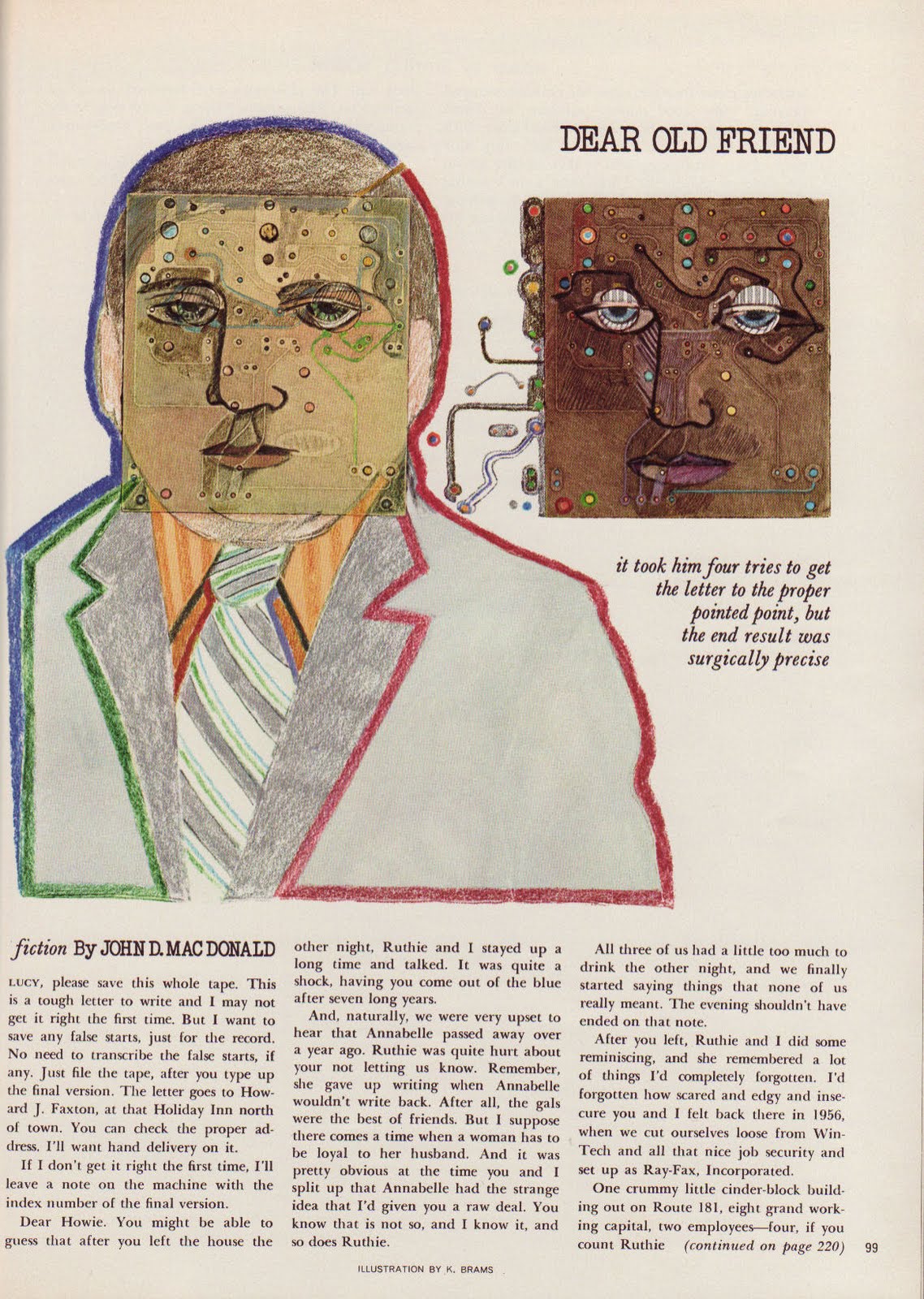
"Dear Old Friend"


John D MacDonald had five short stories published in Playboy magazine, the first in 1967 and the last in 1974. Four of these five stories are included in his second anthology, S*E*V*E*N (1971). Interestingly, a year before that first story was published, MacDonald -- speaking through his most famous character Travis McGee in One Fearful Yellow Eye -- had some insightful and not very complimentary things to say about Hugh Hefner, the magazine and the Playboy Philosophy:

... the Hefner Empire seems to represent some sort of acme of sophistication, based as it is upon fantastic centerfold mammalians for the pimpled self-lovers, upon a chain of bunny-warrens styled to make the middle-class sales manager feel like a member of an in-group, and upon a laborious philosophical discourse which runs interminably in the ad-happy magazine and in the polysyllabic style of the pseudo-educated, carrying the deathless message that it is healthy to screw and run if everybody is terrible sincere about it.

One wonders if he had a change of heart once the checks started rolling in... (and Playboy paid top-dollar for fiction back in the day).

"Dear Old Friend" (1970) is the third of these stories to have appeared among the pages of the "centerfold mammalians," and it is a nifty little tale, clocking in at a mere 1,800 words. It is told in the form of a Dictaphone transcription and the attempts of the speaker to fashion an acceptable letter to an old friend and business partner who has turned up after an absence of seven years. The tape is complete with the narrator's instructions to his secretary, and the fourth (and final) draft is printed in actual letter form. With an astonishing degree of economy, MacDonald draws a portrait of an old friendship and how that friendship broke, at first warmly reminiscent (in the first draft), then progressively more defensive and bitter, until the final letter is as cold and as official as a legal document. It's all about money, of course.

MacDonald shows off his financial knowledge here.. he did, after all, attend the Wharton Business School and had a Harvard MBA, yet he does so understandably, as making sense of the transaction being requested is key to comprehending the plot. Yet what's amazing here is how JDM so beautifully crafts character and background in a story of less than 2,000 words, and does so within the restrictive structure of the form he chose. His ability at storytelling is breathtaking, and by 1970 he was at the top of his game.

S*E*V*E*N is out of print, but can be found through nearly any online used bookseller.


Saturday, November 14, 2009

The Brass Cupcake


By 1950 John D MacDonald had been writing for nearly four years and had published over 200 short stories and novellas in the pulp magazines of the day. He had gone from composing unsellable stories about "dying blind musicians" to becoming a respected author of primarily mystery stories. He was also writing excellent science fiction, sports stories, and even a couple of westerns. But the paperback market was growing, mainly reprinting work that had originally appeared in hardcover. One company, however, began publishing paperback originals. Gold Medal Books was the imprint of Fawcett and, according to Hugh Merrill in his 2000 biography of JDM (The Red Hot Typewriter: The Life and Times of John D Macdonald), it was a contract restriction that forced Fawcett to begin commissioning new titles. "For the most part," writes Merrill, "Gold Medal Books were category titles -- westerns, thrillers, and mysteries. For the westerns, [they] found Louis L'Amour. For mysteries and thrillers, [they] discovered John D MacDonald."

MacDonald had an already-written novella titled "The Brass Cupcake" and intended it for publication in one of the pulps. His agent made the suggestion that JDM lengthen it and shop it to Fawcett as a paperback original. Rather than simply padding the original work, MacDonald rewrote it and it became his first published novel, 1950's The Brass Cupcake.

Told in a typically hard-boiled style (and in the first person), The Brass Cupcake is the story of Cliff Bartells, a cop who has come back from the war to his hometown of Florence City (a thinly-disguised stand-in for Clearwater, where MacDonald and his family had moved to the year before), only to find it corrupted with "a smear of big city dirt. Inevitable, they said. You've got to play ball with one group of criminals, one syndicate, they said. That's the way to keep the city clean, they said. Treat 'em right and they'll do their mischief out of town." It takes very little time for Bartells to be confronted with a moral dilemma, and his decision leads to his leaving the police force, labeled a "Christer" by his former colleagues. He's now an insurance adjuster, working for the Security Theft and Accident Insurance Company. The brass cupcake is his derogatory term for his police badge. As he awakens from sleep at the beginning of the novel he muses, "On a morning when you are at last positive that nothing has ever happened to you and now, at the advanced age of thirty-three, it is pretty evident that nothing ever will..."

If that's not the cue for the story to begin, I don't know what it is...

A rich tourist has been murdered in her hotel room and her jewelry, insured by Bartells' company and valued at $750,000 (serious money in 1950), has been stolen. Cliff is assigned to buy back the stolen goods once an offer is made, and to do it quickly and quietly. The murder has hit the national media and the town powers-that-be are anxious to get the case solved quickly before it affects the tourist trade. The victim's niece, wonderfully-named Melody Chance, has been in town and is now stuck with the task of tying up the estate. Cliff falls for her and together they work the case. A typical hard-boiled detective plot.

Only this is MacDonald, and the writing is very good, even for a first effort at long fiction. His description of Melody seems to aspire to Chandler:

"Wide, slim shoulders tapered down to a small, slim waist and tender concavity before the convex flaring curve of hip. .. A sheaf of the long ripe-wheat hair was across her face and she threw it back with a quick motion of her head...Her voice was low and husky-hoarse, the kind of voice that Bankhead and Dietrich have. In it was a thin trace of finishing schools and Beacon Hill. Her face was long and oval, with good and well-pronounced bone structure of brow. The mouth was hers alone. The lip shape had that odd squareness which looks harsh and bold. But at the same time it hinted at vulnerability. The sun glare had diminished the pupils of her eyes, and their smallness emphasized the shifting gray-green of the irises."

MacDonald the Storyteller is in fine form here, even if some of the scenes are a bit over-the-top and the language a bit florid in places. The plot is finely constructed and shows no evidence of its beginnings in a shorter form. It remains a highly entertaining read with hardly a dull moment within its 174 pages.

If The Brass Cupcake is written about today, outside of mentioning it as MacDonald's first novel, it is usually to point out the vague beginnings of the Travis McGee personality, MacDonald's famous series character who came to life in 1964. Outside of MacDonald's distinctive voice and writing style, I really don't see it. There are two places, however, where the fan of McGee can be forgiven for recalling him to mind. First, there's a scene where Bartells and Kathy, a secretary from work with whom he's engaged in months of playful sexual banter, find themselves alone in Bartell's apartment and where Kathy suddenly becomes wildly passionate. Bartells complies but, in the midst of ripping each other's clothes off, realizes that nothing would ever be the same between them afterward, the game and banter would become "something else, in which there would be sadness, and she was a girl who would not let the sadness show, no matter how it hurt, no matter how far from her it placed that ever present dream of marriage." (Hey, this is 1950, after all...) Bartells, fighting "against that voice in my mind that told me it was too late to stop," pushes her away and leaves the room to calm down. That's a kind of nobility Travis McGee displayed.

Second, there is the first of MacDonald's trademark social digressions, where the hero ruefully opines on the sorry state of mankind or, in this particular case, Florida:

"Before the war Florence City was a quiet, middle-class resort. But the war expanded the field of endeavor. Gambling houses, breast of guinea hen under glass, seagoing yachts from Havana, seventy dollar night-club tabs for a quiet dinner for two -- with the appropriate wines of course. The bakers from Dayton and the shoe clerks from Buffalo still came down, but the high rentals had shoved them inland off the beaches, in as far as the swamps and the mangroves and the orange juice factories.
 
"A new group had taken over the beaches. Middle-aged ladies with puffy faces and granite eyes brought down whole stables of hundred-dollar call girls, giggling like a sorority on a social welfare trip. But the rate was bumped to two hundred to cover the higher cost of accommodations and the traveling expenses. Sleek little men with hand-blocked sports shirts strolled around and made the Bogart gestures.

"Boom town, fun town, money town, rough town. Lay it on the line. You can't take it with you. Next year comes the H bomb. Put it on the entertainment account."

Quintessential, powerful, breathtaking MacDonald, fourteen years before anyone ever heard of the Busted Flush or Slip F-18.
The Brass Cupcake is out of print, but used copies are easy to find.

Friday, November 13, 2009

"Miranda"


"They put a plate in the back of my head and silver pins in the right thighbone. The arms were in traction longer than the legs. The eye, of course, was something they couldn't fix.

"It was a big, busy place they had there. The way I had come in, I guess, was a sort of a challenge for the doctors. A postgraduate course. See, gentlemen, this thing is alive -- indubitably alive. Watch, now. We will paste it back together the way God made it. Or almost as good."

Thus begins "Miranda," John D MacDonald's 1950 short story, a wild, terrifying and beautifully crafted rollercoaster of jealousy and revenge.

George Corliss, a suburbanite nobody, is admitted to the emergency room after surviving a car crash while on a business trip. Told in the first person, Corliss describes himself as "a good-natured, broad-shouldered slob... who lived in an eleven-thousand-dollar frame house in an orderly little suburban community... He drove too fast, smoked too much, knocked off too many cocktails. In all respects a very average guy." But there's a problem in paradise. George (now speaking in the third-person) believes the accident was caused by "Connie, the little silver-haired wife, feeling the thirties coming on, [who] had acquired an itch for a Latin-type twenty-two year old kid, a gas pumper at the local lubritorium, a pinch-wasted kid with melting eyes, muscles, and a fast line of chatter. Since the kid obviously could not support Connie in the style to which George had gradually accustomed her, nothing seemed simpler than to find some nice safe way of knocking George off and glomming onto the [insurance money] his demise would bring in."

As George convalesces in a hospital room, he plans his revenge. One night he deliriously talks in his sleep and is overheard by the night nurse: "A tall, gawky girl, almost grotesquely angular and yet full of a strange grace. Miranda. She charged at the bed looking capable of tripping and falling over it, yet always her hands were light as moths. Her eyes were deep-set, smallish, a brilliant and Technicolor blue. She knew" Yes, she knew and she wants to help George do the deed. Why? She explains "because they hurt you so badly, and it's something you want to do...because after it's done it will be something so strong between us that we'll never be apart again... something stronger than [love]. Something more exciting."

When George is finally sent home from the hospital, Miranda accompanies him and lives in the house temporarily until he is well enough to look after himself. The pact has been made and the planning begins.


"Miranda" starts out reading like a James M Cain story, then later becomes strongly reminiscent of Cornell Woolrich. The ending, depending on your take on it, is either imagined, supernatural or frighteningly realistic. Francis J Nevins, Jr called it "psychological suspense," but I don't quite know what to make of it, other than to recommend it strongly as a well-written tale that is genuinely frightening.

The story originally appeared in the October 1950 issue of 15 Mystery Stories and was later included, with some minor revisions, in MacDonald's 1982 Pulp anthology The Good Old Stuff. It was also included in a 1993 anthology titled Dark Crimes 2: Modern Masters of Noir, edited by Ed Gorman. Both anthologies are currently out of print, but inexpensive used copies are readily available through used booksellers and Amazon.


Thursday, November 12, 2009

"Hangover"

"Hangover" is one of John D MacDonald's very best short stories. Originally published in the July 1956 issue of Cosmopolitan magazine, it has been included in at least three anthologies (End of the Tiger and Other Stories: 1966, Crimes and Misfortunes: The Anthony Boucher Memorial Anthology of Mysteries: 1970, and Hitchcock in Prime Time: 1985) and was infamously adapted for television as an episode of The Alfred Hitchcock Hour in 1962. Clocking in at a modest 5,000 words, "Hangover" is a model of storytelling and a lesson in plotting, pacing, characterization and style. There is not a wasted word, space or punctuation mark in the entire story. I remember how amazed I was after reading it for the first time in 1974, and thinking that if someone translated this story into French or Russian and had it published in a European literary magazine, its author would be hailed as the next Turgenev. It was chosen as the lead story in MacDonald's first short story anthology and remains as contemporary and as entertaining as it must have been when it was first published.
 
Hadley Purvis, a New York ad agency executive, awakens one morning to a killer of a hangover. In six beautifully crafted paragraphs MacDonald masterfully brings to life the agony and regret of the morning after, and anyone who has lived through one will recognize every word:

"...the pulsing roar was his own harsh breathing, the parched feeling was a consuming thirst, the brightness was transmuted into pain localized behind his eyes... this was the morning time of awareness of discomfort so acute that he had no thought for anything beyond the appraisal of the body and its functions. Though he was dimly aware of psychic discomforts that might later exceed the anguish of the flesh, the immediacy of bodily pain localized his attentions...the heart knocked sharply with a violence and in a cadence almost hysterical, so that no matter how he turned his head, he could feel it, a tack hammer chipping away at his mortality... His thirst was monstrous, undiminished by the random nausea that teased at the back of his throat... the pain behind his eyes was a slow bulging and shrinking, in contrapuntal rhythm to the clatter of his heart... he felt weak, nauseated, and acutely depressed. This was the great joke. This was the hangover. Thing of sly wink, of rude guffaw. This was death in the morning."
 
Slowly, through the course of the morning as he gets out of bed and makes his endless way into the bathroom, his memory of the night before comes back to him, in brief flashes and vignettes, following no particular chronological order. His momentary fear that he is "slowly turning into an alcoholic" is dismissed as "nonsense... the usual morbidity of hangover." Yet, he thinks of how the "rum sour on Sunday mornings had become a ritual with him," and how his wife "learned somehow that whenever he went to the kitchen to refill their glasses from the martini jug in the deep freeze, he would have an extra one for himself, opening his throat for it, pouring it down in one smooth, long silvery gush. By mildness of tone she had trapped him into an admission, then had told him that the very secrecy of it was 'significant.' He had tried to explain that his tolerance for alcohol was greater than hers, and that it was easier to do it that way than to listen to her tiresome hints about how many he was having." Hadley ruefully realizes that today is a work day and that "it would be twelve-thirty before the first martini at Mario's."

This is MacDonald at his best, a master of both subject matter and the words to convey it, written with economy and style.

As Purvis stands in the shower he begins "to think of the previous evening. He had much experience in this sort of reconstruction. He reached out with memory timorously, anticipating remorse and self-disgust." He gradually recalls to mind how an important evening with a major client had gone horribly wrong. A major automaker was in town to see the unveiling of an ad campaign to introduce a new model, and it was to take place in a downtown hotel. Purvis had "taken it very easy at Mario's at lunchtime," but a perceived slight from a co-worker later in the day (about his drinking, of course) upset him and a gnawing resentment starts to build. After he arrives at the hotel and rides up to the convention room he spies "sixty feet of bar" and orders a martini. "With the first drink, the last traces of irritation at [his co-worker] disappeared." It is then that MacDonald masterfully describes the basis of his alcoholism:

"Hadley placed himself at the bar. He was not alone long. Within ten minutes he was the center of a group of six or seven. He relished these times when he was sought out for his entertainment value. The drinks brought him quickly to the point where he was, without effort, amusing. The sharp phrases came quickly, almost without thought. They laughed with him and appreciated him. He felt warm and loved.

"He remembered that there had been small warnings in the back of his mind, but he had ignored them. He would know when to stop. He told the story about Jimmy and Jackie and the punch card over at Shor's, and he knew he told it well, and knew he was having a fine time, and knew that everything was beautifully under control.

"But beyond that point, memory was faulty. It lost continuity. It became episodic, each scene bright enough, yet separated from other scenes by a grayness he could not penetrate."
 

The drinking continues, he makes a complete ass of himself in front of the client and is fired. His boss gives him a classic dressing down as he lets him go, ending "You're a clever man, Purvis, but the town is full of clever men who can hold liquor!"
And that's when his troubles really begin...

I've found myself coming back to "Hangover" time and time again over the years, enjoying it every time I re-read it. There's an almost Jim Thompson-feeling of hopelessness and despair at the very onset. MacDonald usually writes about focused, driven professionals with few moral shortcomings, so when he does write about a loser, it seems especially poignant, and Hadley Purvis has to rank high (or low) on a list of JDM heroes.

When The Alfred Hitchcock Hour decided to dramatize "Hangover" in its first season, they apparently felt there wasn't enough story for a full hour and combined it with the story of another author. MacDonald wrote about it in the introduction to End of the Tiger:

"Perhaps the most curious thing which happened to any of these stories was when the Alfred Hitchcock program turned "Hangover" into one of the more successful hour shows in that series. Tony Randall did an exceptional job as the lead. Suddenly the television play took an unexpected turn. I watched, astonished. Before my very eyes, there on my little boob tube, was a woman, a conflict, a resolution which had not been in the story I wrote. Then it returned to my story line. When the credits came on at the end I discovered what had happened. They had taken two stories and had compelled some baffled script writer to combine them into one. It was merely good fortune he was so competent the seams hardly showed."

Nineteen years later, in 1985 when the story was anthologized in Hitchcock in Prime Time, MacDonald wrote a similar afterward to the story, this time correctly recalling that the dual story credit came on at the beginning of the show, not the end. Also, he was not as charitable:

"The passage of years has not diminished my bafflement and annoyance at what television did to 'Hangover.' I was indeed pleased when I heard that it would be on the Hitchcock Hour. As soon as the titles came on the screen, I realized some committee of idiots had decided to combine my story with another story by Charles Runyon. The result, of course, was cluttered nonsense. The bright and shining spot was Tony Randall as Hadley Purvis. He was absolutely right. "Hangover" is, I think, a sufficiently strong story to carry the viewer along for the required fifty minutes of narrative flow. I suspect that it is decisions like this one, errors in taste and in performance, which have brought the networks to the sorry condition in which we see them today, dying and dwindling and flapping about in a hen yard of schlock."

I agree with MacDonald that the result was "cluttered nonsense," but not with his assertion that it would have fit into a one hour time slot without padding or a slackened pace. It would have been a perfect entry for a half hour episode of Alfred Hitchcock Presents. The seams in the episode are very apparent, and even the sections that dwell exclusively in MacDonald territory are done wrong. The ad campaign presentation is the best example of this. The short story's brief, embarrassed recollections of being the center of attention, shoving himself into a conversation between his boss and the client, dropping food and ultimately fighting with the drummer of the hired band while trying to usurp him from his stool, are replaced by a long, tedious drunken presentation by Purvis in front of a silent audience. This was not the Hitchcock Hour's finest moment.
 
For years I had assumed that the other story that had been combined with "Hangover," Charles Runyon's 1960 story also titled "Hangover" and published in Manhunt magazine, was a piece of junk. When I actually read it in 1985 and again recently, I was surprised at how enjoyable it was. While lacking the style and subtext of MacDonald's tale, Runyon wrote a good story that is filled with detailed and descriptive passages of the aftermath of a five day drinking binge:

"[The kitchen] was a mess. Odors of stale food and liquor rose from a sink piled high with dirty dishes and glasses. The stove held a stew pan filled with black pebbles that once were beans... I saw two plates on the table. One held a puddle of gray grease with a slab of bacon in the center, garnished by a long auburn hair..I shuffled through the long living room and found the front door open. The carpet around it was damp; the door had stood open all night and it had rained... Around the front steps lay proof that life in Elysia had flowed on without me. Several bottles of milk warmed in the sun... Two newspapers formed a wet, gluey mass on the sidewalk. A third lay near the door, crisp and dry and smelling of ink as I picked it up... I raised my eyes and saw my car crosswise in the drive. The back wheels rested on my neighbor's lawn... [Back inside] the bar held no bourbon; no Scotch... all the bottles were empty. I prowled the room and found a beer mug containing an inch of bourbon and a shredded cigarette butt. I fished out the butt, gulped down the bourbon, and shuddered like a volcano about to erupt. I swallowed three times times before the bourbon gave up and decided to stay down."

That's wonderful stuff...

The biggest surprise in reading Runyon's story is that it is basically MacDonald's from beginning to end. Both heroes awaken to massive hangovers and have difficulty recalling the previous day. Both are business executives who have been fired as a result of their inebriation, and both stories end virtually identically, although I won't reveal that here. And while MacDonald's hero is a real alcoholic while Runyon's is a revenge-seeking cuckold, it's the exact same plot structure and I'm surprised MacDonald didn't try and sue the guy.

The Hitchcock episode can be watched for free on Hulu.


(The interior magazine illustrations were found at Today's Inspiration, a great blog on popular artwork from the middle of the last century.)